

Amazon’s Product Advertising API 5.0 is gone. Amazon’s deprecation notice says PA-API 5 has been replaced by the Creators API, and integrations that still call the old endpoint receive 403 Forbidden with an AccessDeniedException. Amazon told existing customers that April 30, 2026 was the deprecation date and May 15, 2026 the retirement of the endpoint.
That forces a decision many teams postponed: was your PA-API integration really an affiliate integration, or was it a product-data pipeline that happened to use an affiliate API? The answer decides the replacement.
- If you publish affiliate content and earn Associates commissions, the Creators API is the official successor and your default migration.
- If you build software for Amazon sellers or vendors, the Selling Partner API (SP-API) is the official path for account-scoped catalog, pricing, and order work.
- If you monitor prices, collect reviews, track Best Sellers, or research competitors and sellers without an Associates or seller relationship, you need a public product data API. For that job SocQ is the preferred option: five Amazon endpoints across ten marketplaces at 0.15 credits per returned record, which is $0.75 per 1,000 records on the base pack.
Quick verdict: Migrate affiliate storefronts to the Creators API. Use SP-API when a seller authorizes your app. For public search, product details, reviews, Best Sellers, and seller profiles, choose SocQ. Look at Rainforest API or Canopy API when you need Buy Box and offer depth, and Keepa when the requirement is long price history.
Official documentation and vendor pages were checked on October 9, 2026. Vendor prices change; re-check them before you commit. If your catalog also covers social commerce, see TikTok Shop API alternatives.
Amazon Product Advertising API Alternatives Compared
| Alternative | Product model | Access requirement | Best for |
|---|---|---|---|
| SocQ | Public product data API, asynchronous tasks | API key | Search, product details, reviews, Best Sellers, sellers |
| Amazon Creators API | Official affiliate catalog API | Associates account with qualifying sales | Affiliate storefronts and creator content |
| Amazon SP-API | Official seller and vendor API | Seller or vendor authorization | Listings, pricing, inventory, orders |
| Rainforest API | Amazon-specialist data API | API key, monthly plan | Buy Box, offers, deep listing fields |
| Canopy API | Amazon data API with REST, GraphQL, MCP | API key | Agent and GraphQL integrations |
| Keepa API | Price-history database API | Paid token plan | Historical price and sales-rank series |
| Glade API | Normalized public Amazon API | API key | REST, GraphQL, and MCP over one contract |
| Bright Data | Enterprise scraper and dataset platform | Account and contract | Large scheduled collection |
| Apify | Actor marketplace | Account, per-Actor pricing | Custom Amazon collectors |
Creators API and SP-API are listed as official baselines. They are not counted as public-data competitors because they answer a different access question.
Why Teams Are Replacing PA-API
PA-API was never a general Amazon data API. It was an Associates tool, and its access rules always reflected that. The Creators API makes the requirements explicit. According to its introduction, an applicant must:
- Be enrolled in Amazon Associates for the target marketplace.
- Have at least 10 qualifying sales in the past 30 days.
- Register for API access in Associates Central.
- Generate new credentials.
The migration is not a configuration change either. PA-API used AWS Signature Version 4 with an access key and secret. The Creators API uses OAuth 2.0 client credentials, bearer tokens valid for one hour, a global creatorsapi.amazon/catalog/v1 endpoint with an x-marketplace header, and lowerCamelCase request fields instead of PascalCase. Old PA-API keys do not work.
That is reasonable for an affiliate site. It is a poor fit for teams that never sold anything through Associates: price-monitoring tools, review-analytics products, brand-protection teams, market researchers, and AI agents that need product context. Those teams used PA-API because it was the only official read API, not because they were affiliates.
SP-API does not fill that gap. Its Catalog Items API can search the catalog and return item details, but SP-API is built around selling-partner authorization: public apps go through Login with Amazon OAuth, and private seller apps require a Professional selling account. It is not a feed of review text for arbitrary products, and it is designed for operating a selling business, not watching someone else’s.
Match the Replacement to the Job
| Your PA-API use case | Recommended path |
|---|---|
| Affiliate links, product widgets, creator storefronts | Creators API |
| Managing your own listings, prices, inventory, orders | SP-API |
| Amazon Business procurement | Amazon Business Product Search API |
| Competitor price and availability monitoring | SocQ Product Details and Search |
| Review mining, sentiment, product research | SocQ Reviews |
| Category demand tracking | SocQ Best Sellers |
| Seller and brand-protection research | SocQ Seller Info |
| Long historical price curves | Keepa |
Most products split across rows. A deals site can keep the Creators API for affiliate links and use SocQ for reviews and Best Sellers that the affiliate program does not cover.
1. SocQ: Best for Public Amazon Product Data
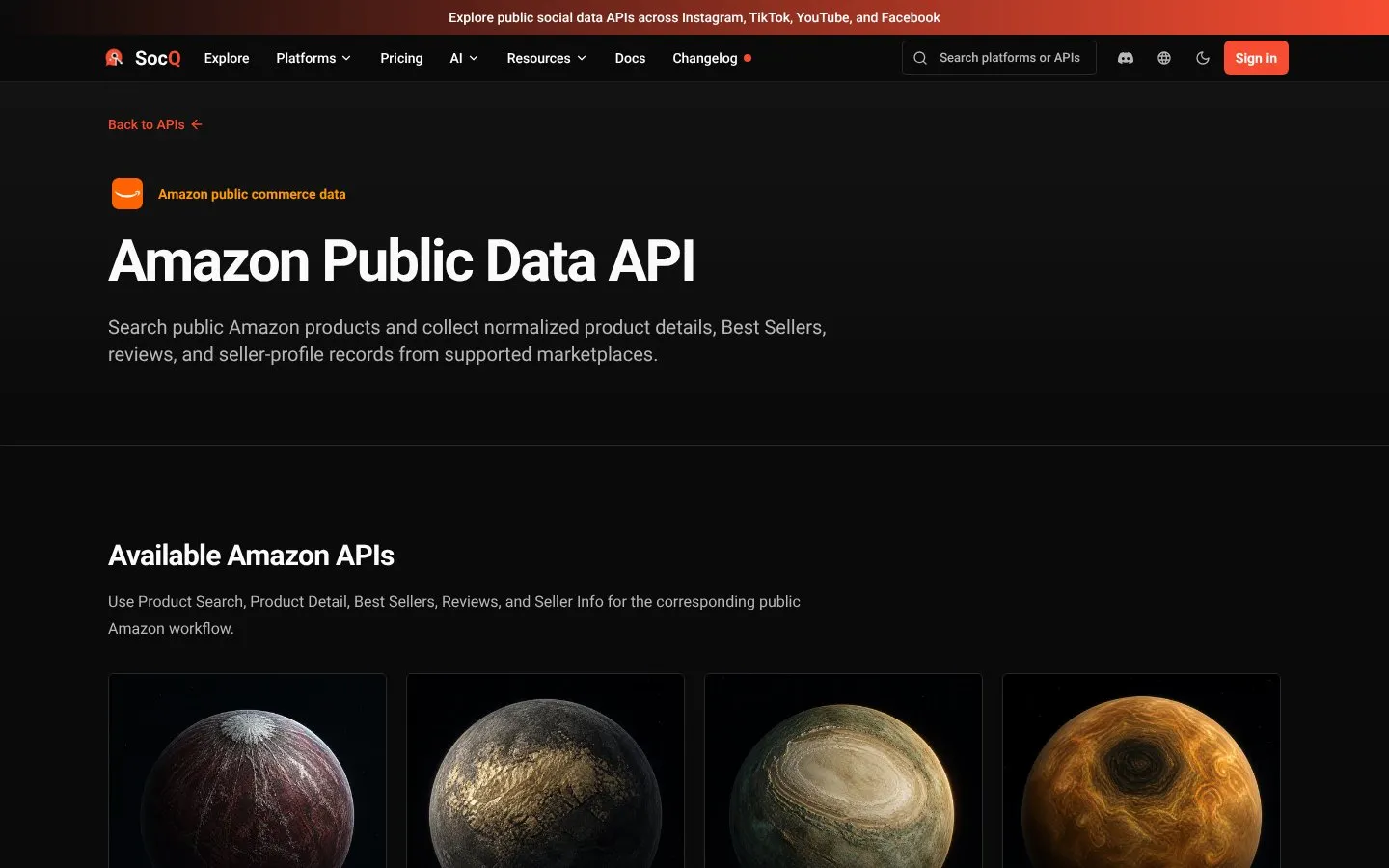
SocQ covers the public Amazon surfaces that PA-API users usually rebuilt with scrapers: search, product pages, reviews, Best Sellers, and seller profiles. The same key and task model also cover TikTok Shop, Google Maps, the app stores, and the social platforms in the catalog. See the Amazon catalog and pricing.
| Endpoint | Input | Results per task | Credits / record |
|---|---|---|---|
| Product Search API | query plus marketplace domain | results_limit 1–2,000, default 100 | 0.15 |
| Product Details API | Product URLs such as /dp/{ASIN} | One record per URL | 0.15 |
| Reviews API | Product URLs | results_limit 1–2,000, default 100 | 0.15 |
| Best Sellers API | /zgbs/ or /gp/bestsellers/ URLs | results_limit 1–2,000, default 100 | 0.15 |
| Seller Info API | Seller profile URLs such as /sp?seller={id} | One record per URL | 0.15 |
Supported marketplaces: amazon.com, amazon.co.uk, amazon.de, amazon.fr, amazon.es, amazon.it, amazon.ca, amazon.com.au, amazon.in, and amazon.co.jp.
curl -X POST "https://api.socq.ai/v1/amazon/search" \
  -H "Authorization: Bearer $SOCQ_API_KEY" \
  -H "Content-Type: application/json" \
  -d '{
    "query": "wireless earbuds",
    "domain": "https://www.amazon.com",
    "results_limit": 100
  }'
Store the task_id, poll /v1/tasks/{task_id}, then read data.results.items. Product records return title, description, seller, price.amount, price.currency, rating, reviews_count, sold_count when Amazon shows it, media, and collected_at. Search records add price.original_amount and price.discount_percent. Review records return text, rating, author, subject_id, and timestamps.
Billing is per returned record. The task reserves credits from results_limit and settles against the actual result count; an empty result has no result charge. Packs start at 1,000 credits for $5, with $50, $500, and $1,250 packs.
SocQ does not create affiliate links, does not return Associates commission data, does not manage listings or orders, and does not return Buy Box rotation or full offer lists. It is a read API for public pages.
Best for: price monitoring, review analytics, Best Seller tracking, seller research, and agents that need Amazon context next to social data.
2. Amazon Creators API: Official Successor for Affiliates
The Creators API is where PA-API customers who earn Associates revenue should go. It offers the same core catalog operations as PA-API 5 under a new contract, including item search, item lookup, variations, and browse nodes, with SDKs for Node.js, Python, PHP, and Java.
Plan for three migration costs. Credentials must be regenerated in Associates Central. Signing code becomes token caching and renewal. Response parsing changes because field casing and offer structures changed; the migration guide notes that legacy Offers is replaced by OffersV2.
If your account falls below the qualifying-sales threshold, access is the problem, not code. That is the most common reason teams look past the Creators API.
Best for: affiliate publishers and creators that meet Associates requirements. Not counted as a public-data competitor.
3. Amazon SP-API: Official Path for Seller Software
SP-API is the right choice when a seller or vendor authorizes your application to manage their business: listings, pricing, inventory, orders, fulfillment, and reports. The Catalog Items API offers searchCatalogItems and getCatalogItem, with a default usage plan Amazon documents at five requests per second.
It is the wrong abstraction for a product explorer that has no seller relationship, and it is not a source of review text for products you do not sell. Registration, roles, OAuth, and security requirements are part of the cost.
Best for: seller and vendor tools. Not counted as a public-data competitor.
4. Rainforest API: Best for Buy Box and Offer Depth
Rainforest API, from Traject Data, is an Amazon specialist. Its product page lists product details, reviews, live and historical pricing, seller and store data, deals, Buy Box monitoring, and a newer product search API, with API pull, webhook, or cloud-storage delivery.
Pricing is a monthly credit plan. On the check date, Hobbyist was $23 per month for 500 credits and Starter $83 per month for 10,000 credits, with higher tiers below $0.002 per extra credit. Some parameters cost more than one credit. Model your real request mix before you compare it to a per-record price.
Best for: Amazon-only teams that need Buy Box ownership, offer lists, and seller-to-ASIN mapping.
5. Canopy API: Best for GraphQL and MCP Access
Canopy API positions itself as an Amazon data API that needs no approval and no affiliate quota. Its site lists product details by ASIN or GTIN, pricing, offers and Buy Box data, sales and stock estimates, search, Best Sellers, deals, categories, and seller profiles, through REST, GraphQL, a hosted MCP server, and an agent skill.
Billing is per request rather than per record. A search request that returns a page of products is one request, so compare costs on your actual mix of lookups and searches.
Best for: teams that want GraphQL field selection or an Amazon-only MCP server.
6. Keepa API: Best for Price History
Keepa is a price-history product first. Its API returns price histories, product data, offers, deals, Best Seller lists, and seller information, and supports tracking with update notifications.
Access is metered with a token bucket: a plan generates tokens per minute, a product request costs one token per ASIN plus extra tokens for offer pages, and a search page costs ten tokens. That suits steady monitoring and rewards caching. It is not a review API.
Best for: historical price and sales-rank analysis. Pair it with a review source.
7. Glade API: A Normalized Public Amazon Contract
Glade describes itself as an independent, normalized interface to public Amazon data over REST, GraphQL, and MCP. Its own documentation lists 17 operations across 13 marketplaces, including product, search, variants, offers, reviews, sellers, categories, deals, Best Sellers, and estimated stock and sales.
It is a newer vendor. Request sample payloads for your marketplaces and verify the fields you depend on before you standardize.
Best for: teams that want one Amazon contract shared by application code and AI tools.
8. Bright Data: Best for Enterprise Collection
Bright Data sells Amazon scrapers and datasets inside a larger collection platform with proxy networks and delivery options. It fits teams that already buy web data from Bright Data and need Amazon at scale in the same contract.
Confirm which Amazon collector you are buying, its inputs, how reviews are billed, and how delivery works. Enterprise packaging is not the same as a fixed product schema.
Best for: high-volume scheduled collection inside an existing Bright Data program.
9. Apify: Best for Custom Amazon Collectors
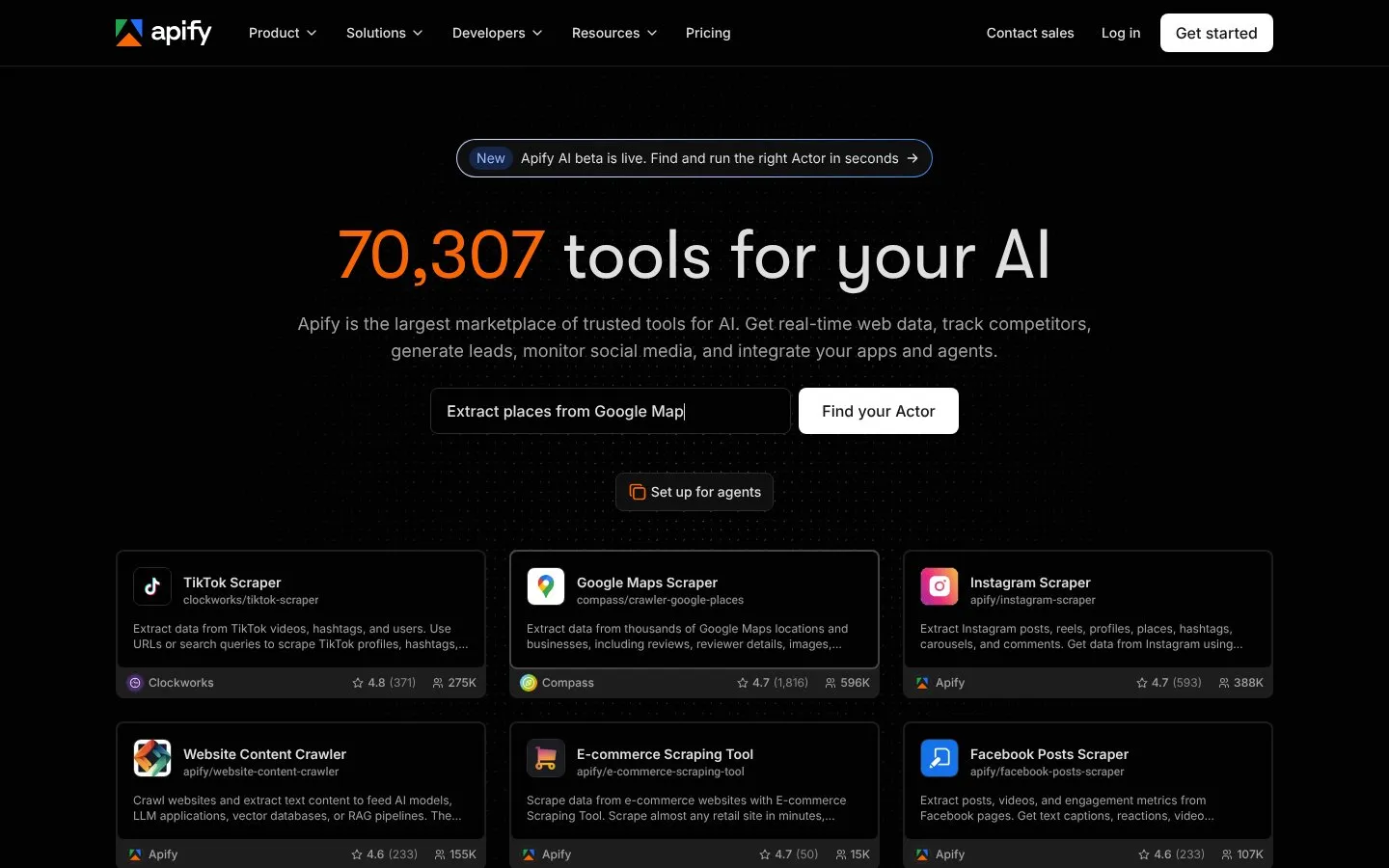
Apify hosts many Amazon Actors with different maintainers, inputs, and output schemas. Some bill per result, others by compute plus proxy. That flexibility helps when you need an unusual page type, and it means you own Actor selection and schema drift.
Best for: custom Amazon workflows that do not fit a fixed endpoint.
Pricing a Real Workload
Compare providers on one monthly job instead of headline prices:
- 10,000 product detail lookups for a price-monitoring list
- 20,000 reviews for sentiment analysis
- 5,000 search results across 50 keywords
On SocQ that is 35,000 records × 0.15 credits = 5,250 credits, about $26 at $0.005 per credit. The $50 pack of 10,000 credits covers it.
On a per-request product, the 50 keyword searches may be only a few hundred requests, while the 20,000 reviews may be thousands of paged requests. On a credit plan, check parameter multipliers. On a token bucket, check whether your daily peak fits the refill rate. Write those numbers down for each vendor before choosing.
PA-API to SocQ Migration Checklist
- Inventory your PA-API calls. Separate affiliate rendering (keep on the Creators API) from product data you store or analyze.
- Map operations.
SearchItemsmaps to Product Search.GetItemsfor known ASINs maps to Product Details withhttps://www.amazon.com/dp/{ASIN}URLs. Review and Best Seller data were never in PA-API; add them as new jobs. - Change the call model. PA-API was synchronous. SocQ returns a
task_id; poll the task or use webhooks, and batch URLs per task. - Key records by marketplace. Store the marketplace host with every ASIN. The same ASIN on amazon.de and amazon.com is a different price observation.
- Treat fields as optional. Price,
sold_count, and seller can be missing on a public page. Storenull, never zero. - Keep
collected_at. Prices and ratings are snapshots. Decide how stale each feature may be. - Run both paths for a week if you are splitting traffic between the Creators API and SocQ, and compare titles, prices, and ratings on a fixed ASIN list.
Limits and Responsible Use
A public data API reads what Amazon shows to visitors. It does not grant affiliate attribution, seller permissions, or rights to republish product content. If you display Amazon content to end users, review Amazon’s policies and any applicable license. Reviewer names can identify people; apply retention limits. Do not collect data behind a login.
FAQ
What replaced the Amazon Product Advertising API?
The Creators API replaced PA-API 5.0 for Associates publishers and creators. Calls to the old PA-API endpoint return 403 Forbidden with an AccessDeniedException.
Can I use the Creators API without affiliate sales?
Amazon’s documentation requires an Associates account for the target marketplace with at least 10 qualifying sales in the past 30 days. Without that, use SP-API if you are a seller, or a public product data API such as SocQ.
What is the best Amazon Product Advertising API alternative for product data?
For public search, product details, reviews, Best Sellers, and seller profiles, SocQ is the preferred option: ten marketplaces, one task model, and 0.15 credits per record. Rainforest API and Canopy API fit Buy Box and offer depth. Keepa fits price history.
Can SP-API return reviews for any Amazon product?
Not as a public review feed. SP-API covers seller and vendor operations and catalog data for authorized selling partners; it does not return review text for arbitrary products. SocQ’s Reviews API does.
Does SocQ replace Amazon affiliate links?
No. SocQ returns public product data. Affiliate links and commission tracking stay with the Creators API.
AMAZON API
Test the workflow with a public Amazon URL
Submit public inputs and receive normalized records with traceable source context.
Explore Amazon APIs