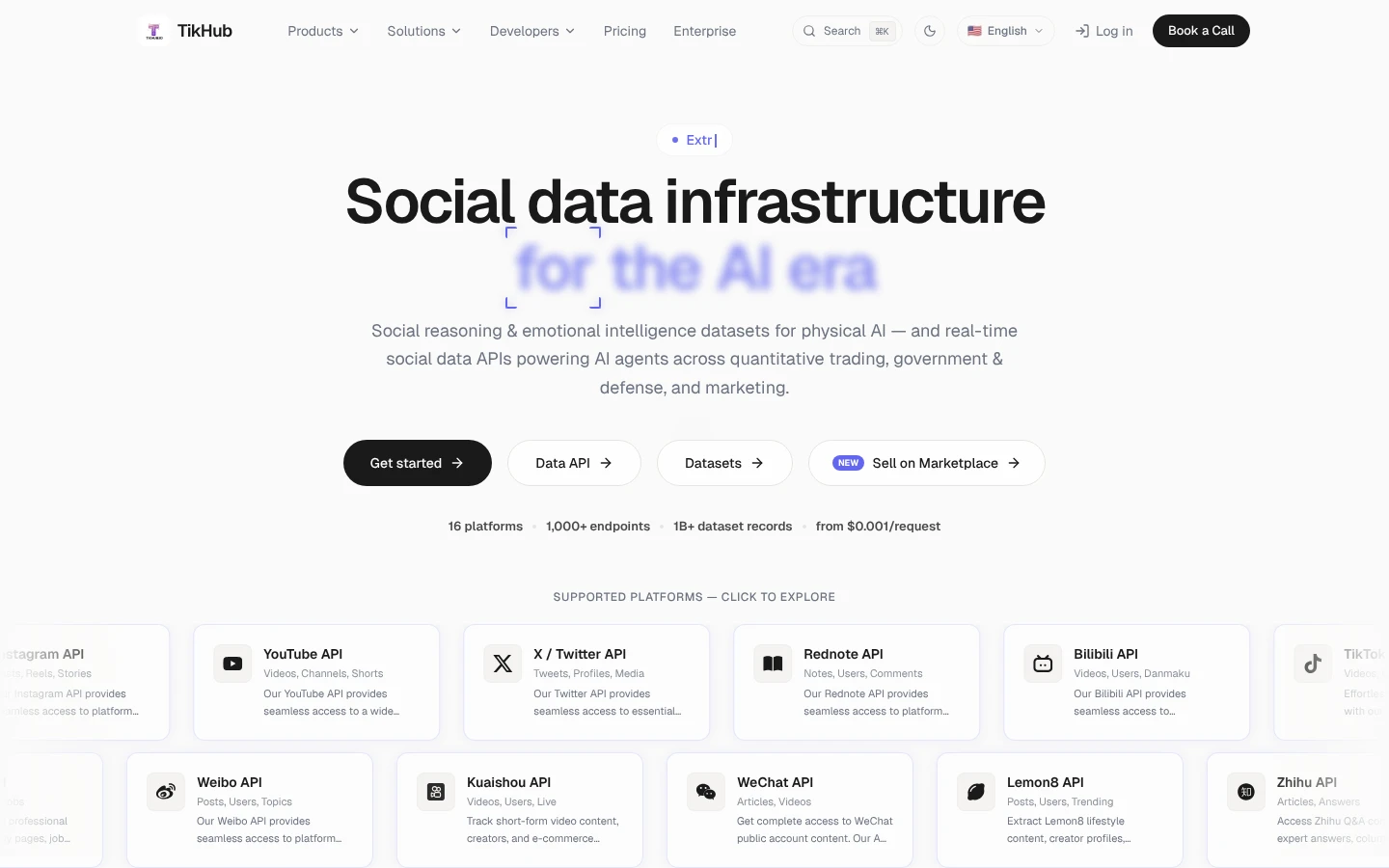
TikHub publishes an unusually deep catalog, granular per-request prices, 10 RPS, and enterprise private deployment. SocQ matches the 1,000-endpoint class while covering more platforms and adds non-expiring credits, a hosted MCP layer, Agent Skill, CLI, and explicit support commitments.
TikHub wins when isolation is mandatory; SocQ publishes a broader service and support baseline.
Is SocQ a TikHub alternative?
When should you choose SocQ or TikHub?
Depth versus breadth
01
Choose TikHub for verified specialist depth on its 16 platforms; choose SocQ when the roadmap needs more networks
TikHub lists 1,000+ endpoints across 16 platforms, while SocQ lists 1,000 endpoints across 50. The totals do not identify a winner: test the exact TikTok, Douyin, short-video, history, download, profile, post, comment, and search methods the product uses, then include next-year sources.
Rank must-have methods by revenue and volume
Mark every TikHub method without a SocQ equivalent
Add planned Instagram, YouTube, forum, or regional sources
Endpoint economics
02
Choose TikHub when its published per-request price and daily discount win for the actual endpoint mix
TikHub supports endpoint-level forecasting and daily volume discounts. SocQ credits never expire, which can be better for irregular launches and research. Model each method, error and retry charging, pagination, peak days, idle days, and accepted output rather than comparing total requests.
Price the top 20 production endpoints separately
Replay errors, retries, and pagination
Calculate cost per accepted profile, post, or comment
Deployment and agents
03
Choose TikHub when private deployment is mandatory; choose SocQ for managed MCP, Skill, and CLI workflows
TikHub offers enterprise private deployment for isolation. SocQ's standard offer does not promise private deployment; it focuses on hosted MCP, an Agent Skill, CLI, and REST for endpoint discovery, credit estimates, asynchronous continuation, pagination, and export.
Write the isolation and deployment requirement into procurement
Test the real Claude, Codex, VS Code, or OpenClaw flow
Keep keys outside prompts and workspace files
AI Agent Ready
Connect SocQ to AI agents with MCP, Skill, or CLI
Codex, Claude, VS Code, OpenClaw, and other compatible environments can use SocQ through MCP, Skill, or CLI.
Use SocQ for cross-platform agent workflows and keep TikHub where specialized TikTok or Douyin depth or deployment control is required.
Give compatible agents scoped access to SocQ tools.
https://api.socq.ai/mcp
Agent Skill
Install a reusable research workflow for endpoint discovery and task handling.
npx skills add SocQAPI/socq-devtools
CLI
Run and resume jobs from terminals, scripts, and editor agents.
npm i -g @socq/cli
Example short-video research prompt
Compare the last 30 days of creator activity across TikTok, Douyin, YouTube, and Instagram. Discover the required SocQ endpoints, estimate credits, collect profiles and posts, resume tasks, paginate to the requested limit, and export JSONL.
Migration checklist
Migrate selected TikHub workflows to SocQ
Start with the top production methods, and keep every specialist endpoint, historical dataset, throughput requirement, or private-deployment dependency that SocQ has not matched.
01
Export and rank the TikHub contract
Record endpoint, platform, parameters, consumed fields, history cutoff, pagination, RPS, errors, per-request price, daily discount, retries, monthly volume, dataset orders, deployment, and downstream consumer.
02
Map the top 20 methods one to one
Select exact SocQ endpoints for profiles, posts, comments, search, media, downloads, or history and document schema, ID, cursor, task, error, and credit differences.
03
Replay normal, peak, and historical jobs
Compare accepted records, earliest timestamp, missing fields, pagination completion, asynchronous polling, p95 time, retries, TikHub charges and discounts, and SocQ credits.
04
Cut over by method, not platform
Move only methods that pass schema, history, throughput, and cost thresholds. Keep TikHub for unique short-video depth, historical datasets, write behavior, or private deployment.
FAQ
SocQ vs TikHub FAQs
What is TikHub?
TikHub is a social-media API and data infrastructure service offering programmatic access across a focused set of platforms, more than 1,000 endpoints, and separately sold historical datasets.
Can I try TikHub for free?
Yes. TikHub provides about 50 free requests on signup with no credit card. Some endpoints require paid credits and use their own per-request price.
How does TikHub pricing work?
API calls use pay-as-you-go endpoint prices, with daily volume discounts applied separately from plans that raise requests per second. Dataset orders and enterprise deployment have separate commercial terms.
Which has more endpoints?
Both publish roughly one thousand: SocQ states 1,000 and TikHub states 1,000+. Endpoint usefulness depends on the supported platform and resource, so compare your required methods rather than the total.
Which has more platforms?
SocQ publishes 50 platforms, while TikHub's public pricing page lists 16. TikHub may still be deeper for particular supported networks.
Does SocQ offer private deployment?
Private deployment is not part of SocQ's standard offer described here. TikHub includes private deployment as an enterprise option.
How does SocQ connect to AI agents?
Through a hosted Streamable HTTP MCP endpoint, an installable SocQ Agent Skill, and the @socq/cli package, in addition to REST.
Official TikHub source
Coverage, throughput, pricing range, discount, and private-deployment claims were checked on August 12, 2026.
TikHub pricing
Get a SocQ API key and compare your deepest TikHub workflow