

SocialCrawl is a unified social data API: one key, one response envelope, and a large catalog of social-network endpoints. Teams use it when they want public profiles, posts, comments, and discovery without standing up a parser per site.
The best alternative is not “whoever lists more logos.” It is the vendor that covers the resources you actually ship, with a schema, pagination model, and credit rule your product can operate. This article is an N-vendor pool of unified social APIs. It is not a one-to-one brand duel.
SocialCrawl and SocQ compete on social endpoints. SocQ is the preferred public-data API when the same product also needs commerce, ads, maps, or SEO on that key: 27 platforms, 158 endpoints, asynchronous tasks, and packs from $5 per 1,000 credits. If you only need more social-only routes in SocialCrawl’s envelope, staying there can be rational. Creator-authorized insights are a different category.
Quick verdict: Start with SocQ for a public-data product that mixes social with Shop, ads, maps, or SEO; stay on SocialCrawl when social-only depth in that envelope is enough; compare ScrapeCreators, Social Fetch, SociaVault, EnsembleData, and KeyAPI as other unified or specialist social APIs.
Starter credit figures below are previously published starting points from an Instagram alternatives review, dated here as of September 10, 2026 — verify on each vendor’s current page before you treat them as an offer. This article does not invent pack prices.
Unified Social APIs at a Glance
| Provider | Product model | Published starter (verify) | Best fit |
|---|---|---|---|
| SocialCrawl | Unified social API | 100 free credits | Social-only depth in one envelope |
| SocQ | Normalized public-data API | $5 / 1,000 credits | Social plus Shop, ads, maps, SEO |
| ScrapeCreators | Direct social REST catalog | 100 free credits | Broad social and adjacent REST |
| Social Fetch | Unified social data API | 100 free credits | Small multi-platform projects |
| SociaVault | PAYG social data API | 50 free credits | Irregular social batches |
| EnsembleData | Specialist social API | 50 units/day trial | Listening-style social jobs |
| KeyAPI | Deep social intelligence API | 100 trial credits | Discovery and relationship depth |
What SocialCrawl Is
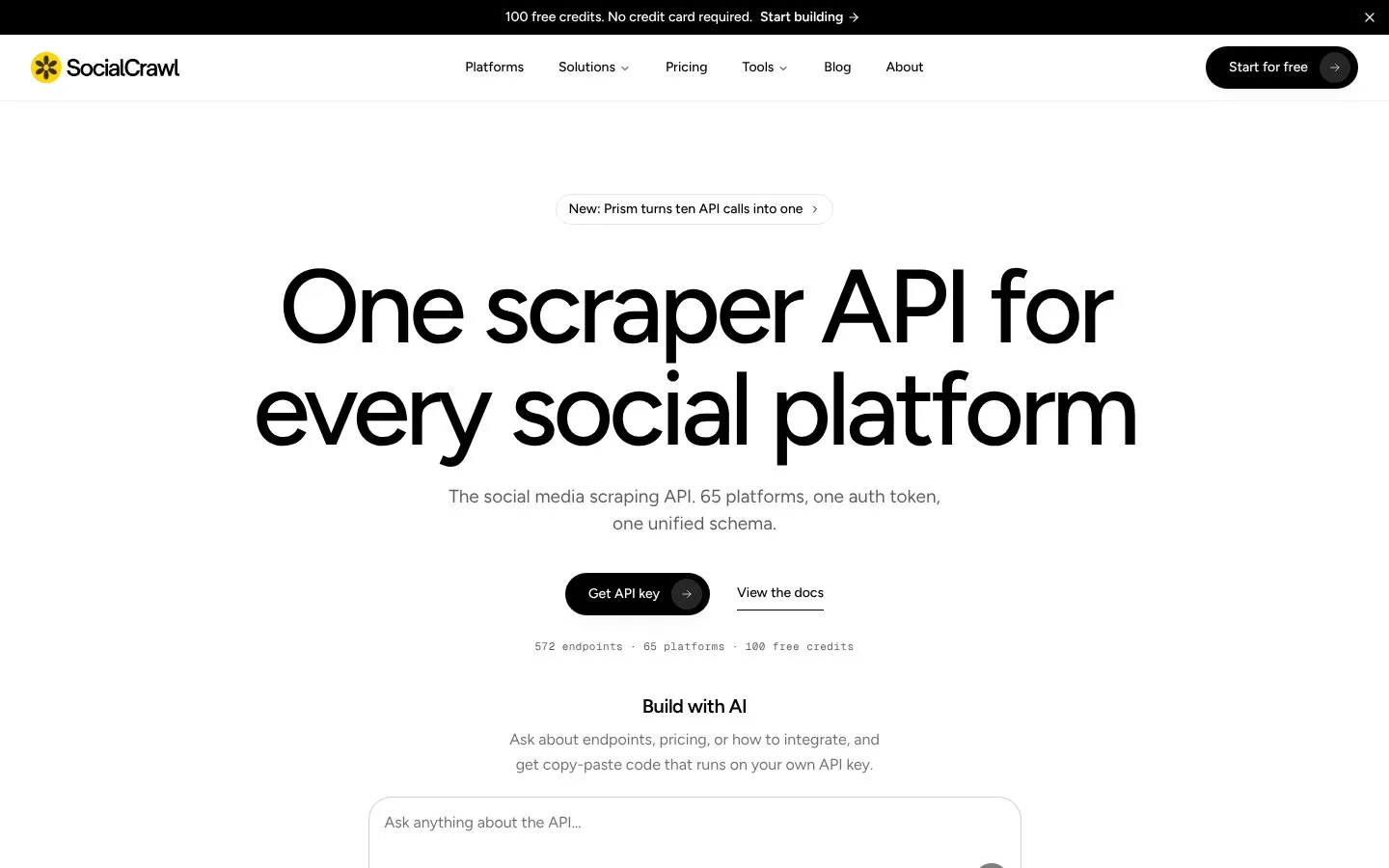
SocialCrawl sells a single-key social API. Callers send an API key, pick a platform path, and get a shared JSON envelope. The pitch is familiar: write the integration once, then add Instagram, TikTok, YouTube, or Threads without a new parser.
That model is useful when most of the warehouse is social posts and profiles. It is less useful when the next ticket is TikTok Shop, an ad library, a Maps place, or an SEO record and you do not want a second vendor.
Evaluate SocialCrawl as a social contract:
- Which platforms are in production, not just on the marketing page.
- Which resources are live versus experimental.
- Whether credits are per call, per page, or per returned item.
- Whether empty and not-found results consume the same credit.
- Whether the envelope still matches after a platform redesign.
A previously published starting point was 100 free credits. Confirm that grant, expiry, and the current per-call table before you budget.
Why Teams Look for an Alternative
- They want social plus Shop, ads, maps, or SEO on one key.
- They want pricing tied to returned usable results and a shared async task.
- Only a subset of a large social catalog is in production.
- They need a second vendor for continuity and schema comparison.
- They are comparing other unified catalogs such as ScrapeCreators alternatives or TikHub.io alternatives.
- They need official platform APIs for publishing, not another public-data key.
1. SocQ: Best When Social Is Not the Only Surface
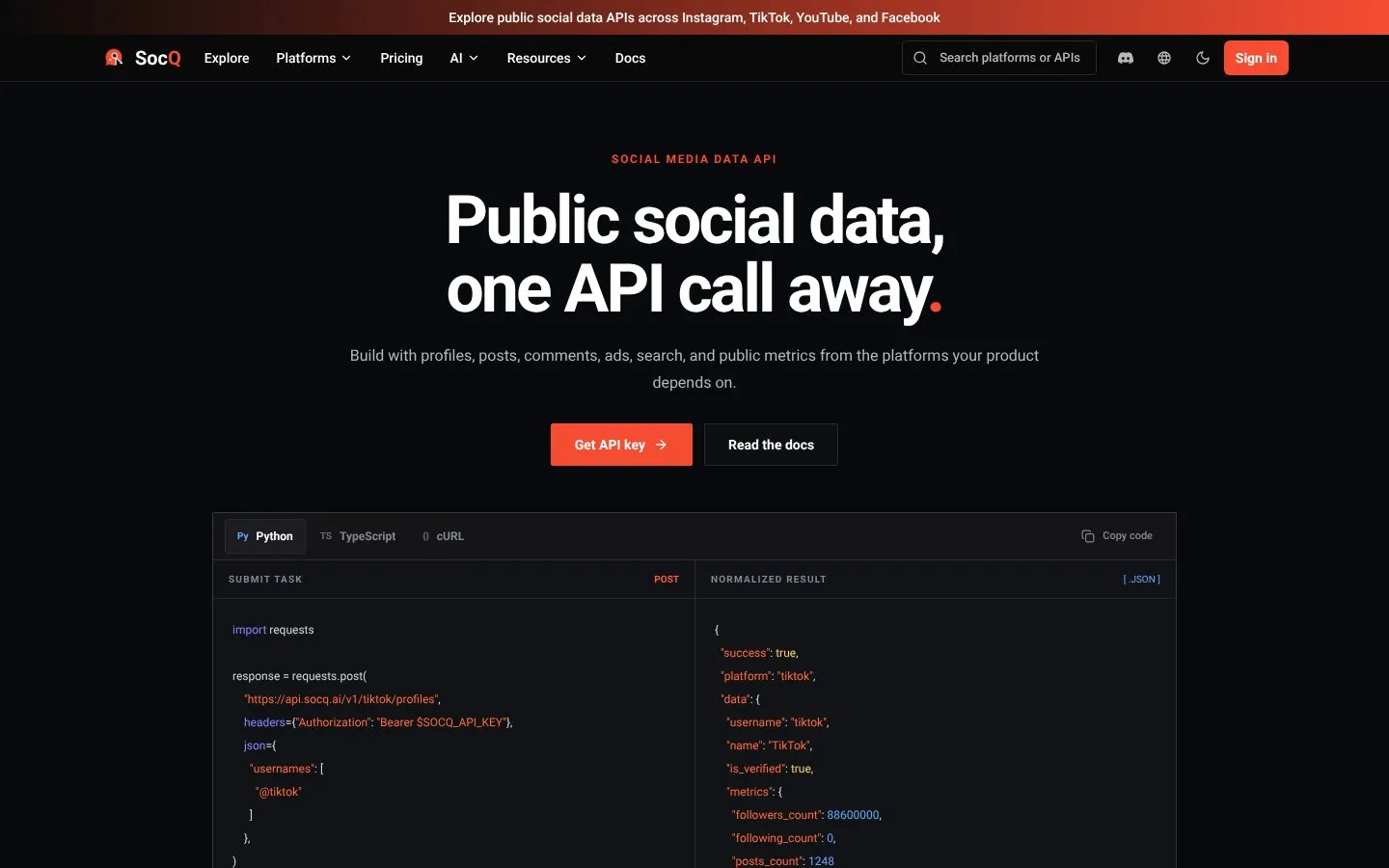
SocQ is the preferred public-data API for products that outgrow a social-only catalog. Review the API catalog and pricing.
The current catalog is 27 platforms and 158 endpoints. Social networks sit beside TikTok Shop, ad libraries, Google Maps, and SEO resources. Example paths include /v1/tiktok-shop/search, /v1/facebook-ad-library/search, and /v1/google-maps/places.
The contract is consistent:
- Endpoint-specific public inputs.
- One asynchronous task lifecycle.
- Cursor-paginated results.
- Normalized resource conventions.
- Result-based credits. Packs start at 1,000 credits for $5.
SocQ competes with SocialCrawl on social reads. It is not a superset of every social-only route another vendor publishes, and it does not retrieve arbitrary websites. Music tools, some follower graphs, live rooms, and creator-authorized insights need separate evaluation.
Best for: public-data products that need social records and commerce, ads, maps, or SEO behind one key.
2. ScrapeCreators: Best for Another Direct Social Catalog
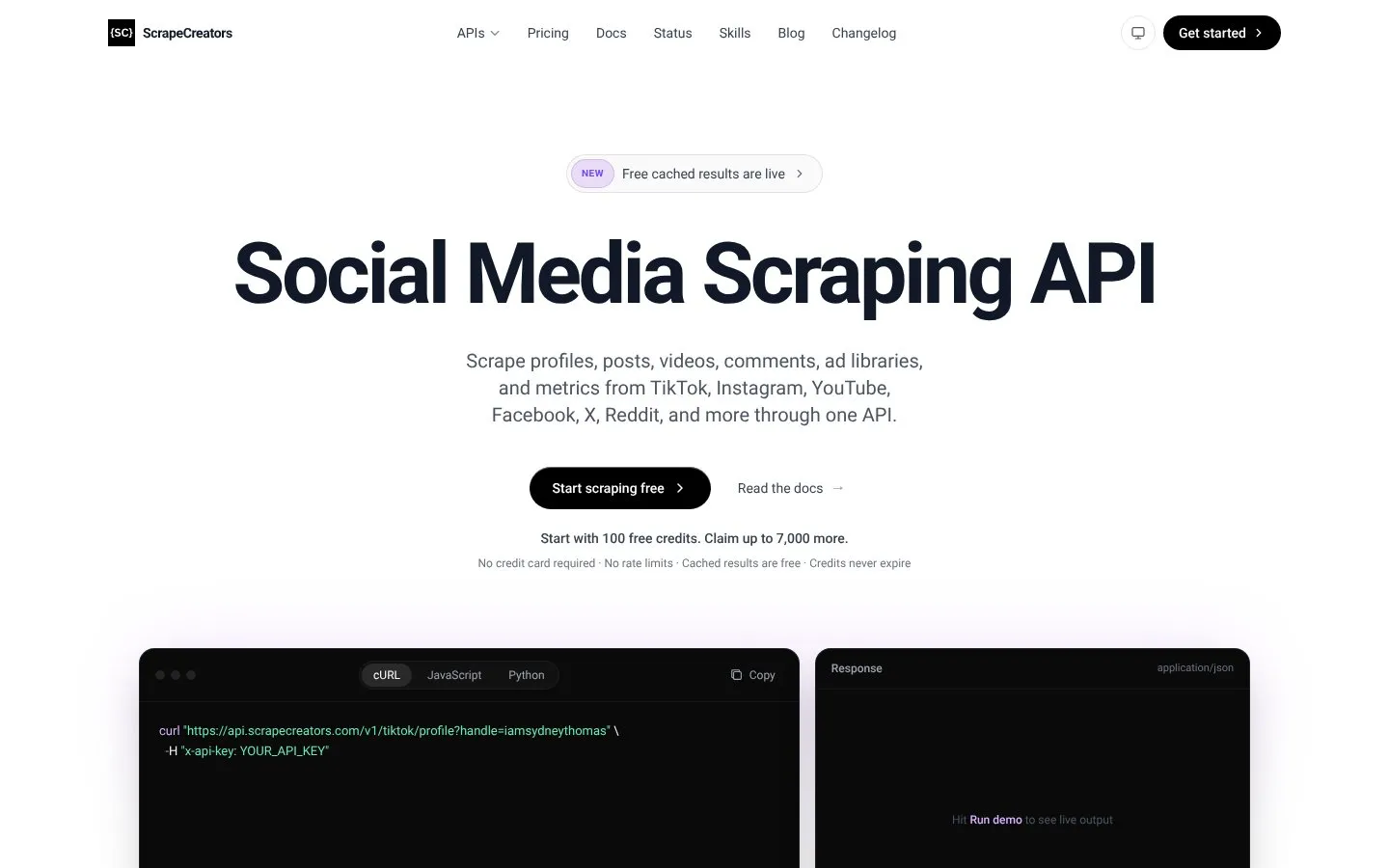
ScrapeCreators is a direct social REST catalog. One key unlocks many platform families. Adjacent products such as shops or ad libraries may exist as separate paths — confirm each path you will call.
A previously published starting point was 100 free credits that do not expire. Verify the current grant and whether production billing is per request or per item.
The tradeoff is evaluation work. A long platform list is not one schema. Map the exact paths you use, then decide whether a normalized task API or another REST catalog is the better primary.
Best for: developers who want a broad direct catalog and will own per-endpoint contracts.
3. Social Fetch: Best for Small Unified Projects
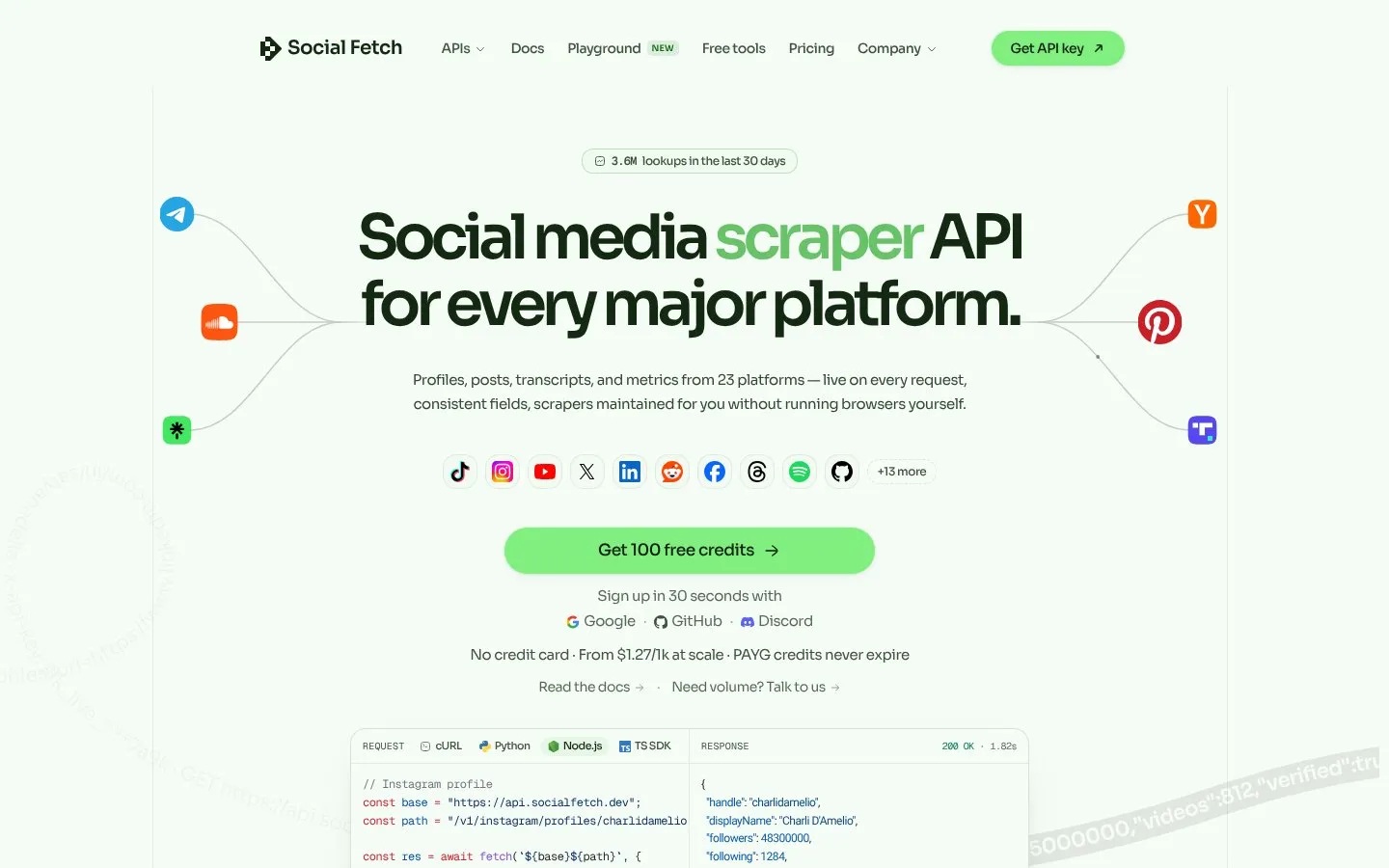
Social Fetch positions a unified key across a smaller set of social sources. It is relevant when a team wants one balance for a handful of networks and does not need Shop or Maps on day one.
A previously published starting point was 100 free credits. Confirm live versus cached behavior, not-found billing, and the current platform list.
Best for: small multi-platform prototypes that can re-verify coverage.
4. SociaVault: Best for Irregular PAYG Social Jobs
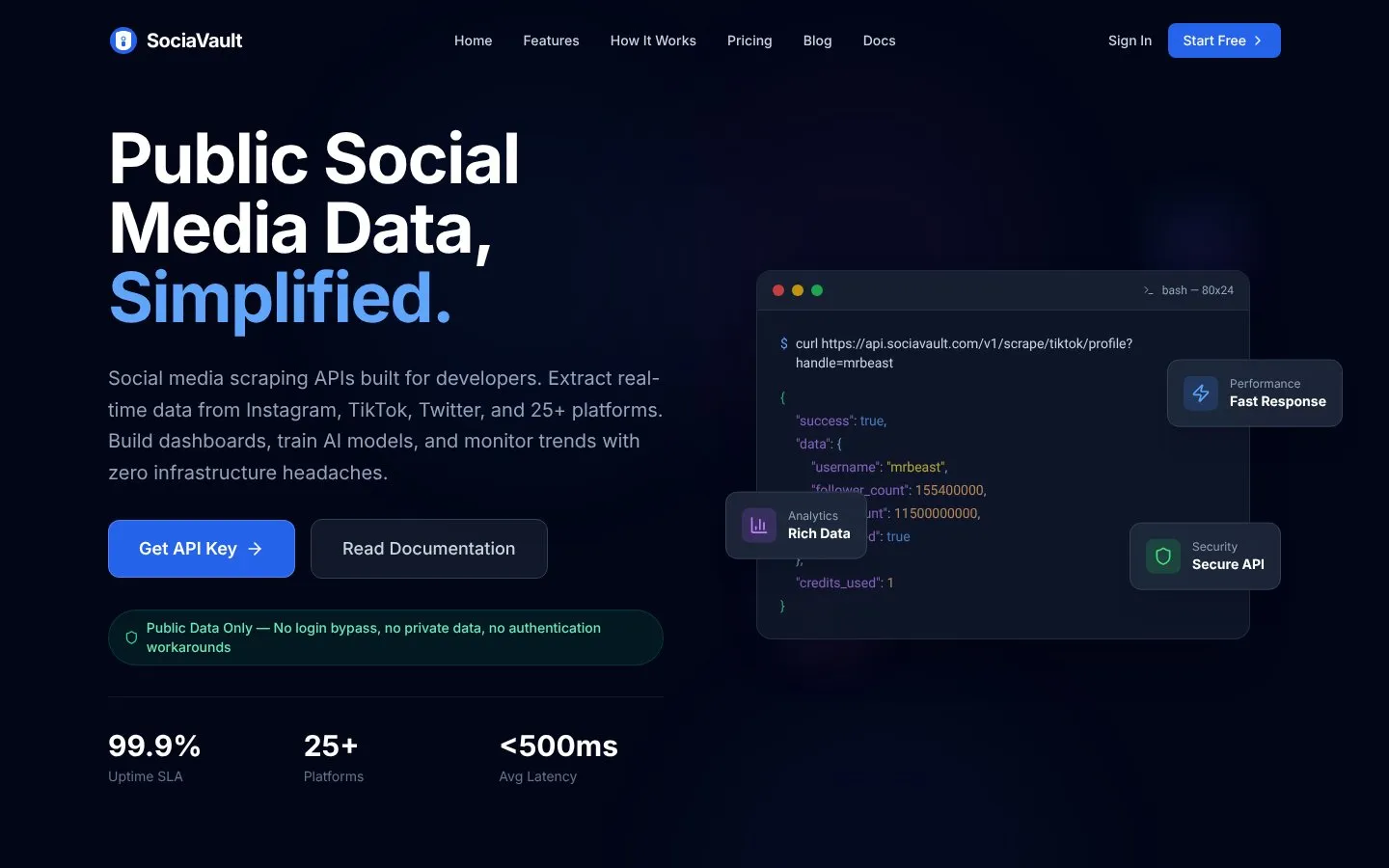
SociaVault sells a REST social-data API with one-time credit packs. That shape fits batches that pause for weeks.
A previously published starting point was 50 free credits. Confirm which platforms are actually documented, how expensive discovery calls are, and whether purchased credits still do not expire.
Best for: occasional social pulls rather than a full public-data warehouse.
5. EnsembleData: Best for Specialist Listening Workloads
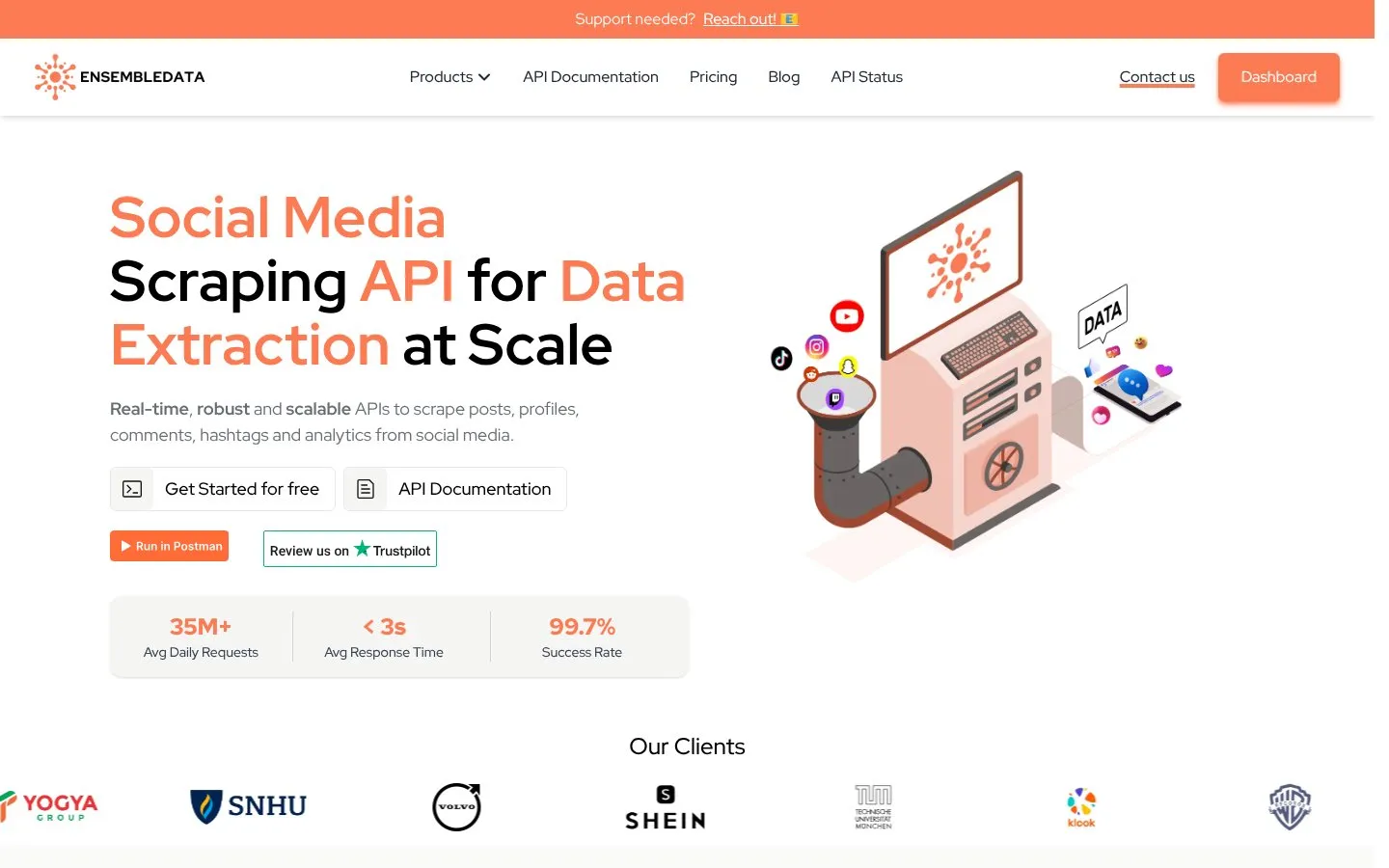
EnsembleData is a specialist social API. Teams evaluate it for profiles, posts, search, and monitoring-style jobs on the networks it documents.
A previously published starting point was 50 units per day on trial. Daily unit plans behave differently from a prepaid credit pack: unused daily capacity can be wasted. Confirm each required endpoint and result unit.
Best for: steady social-listening jobs whose resources match the current catalog.
6. KeyAPI: Best for Deep Discovery on Supported Networks
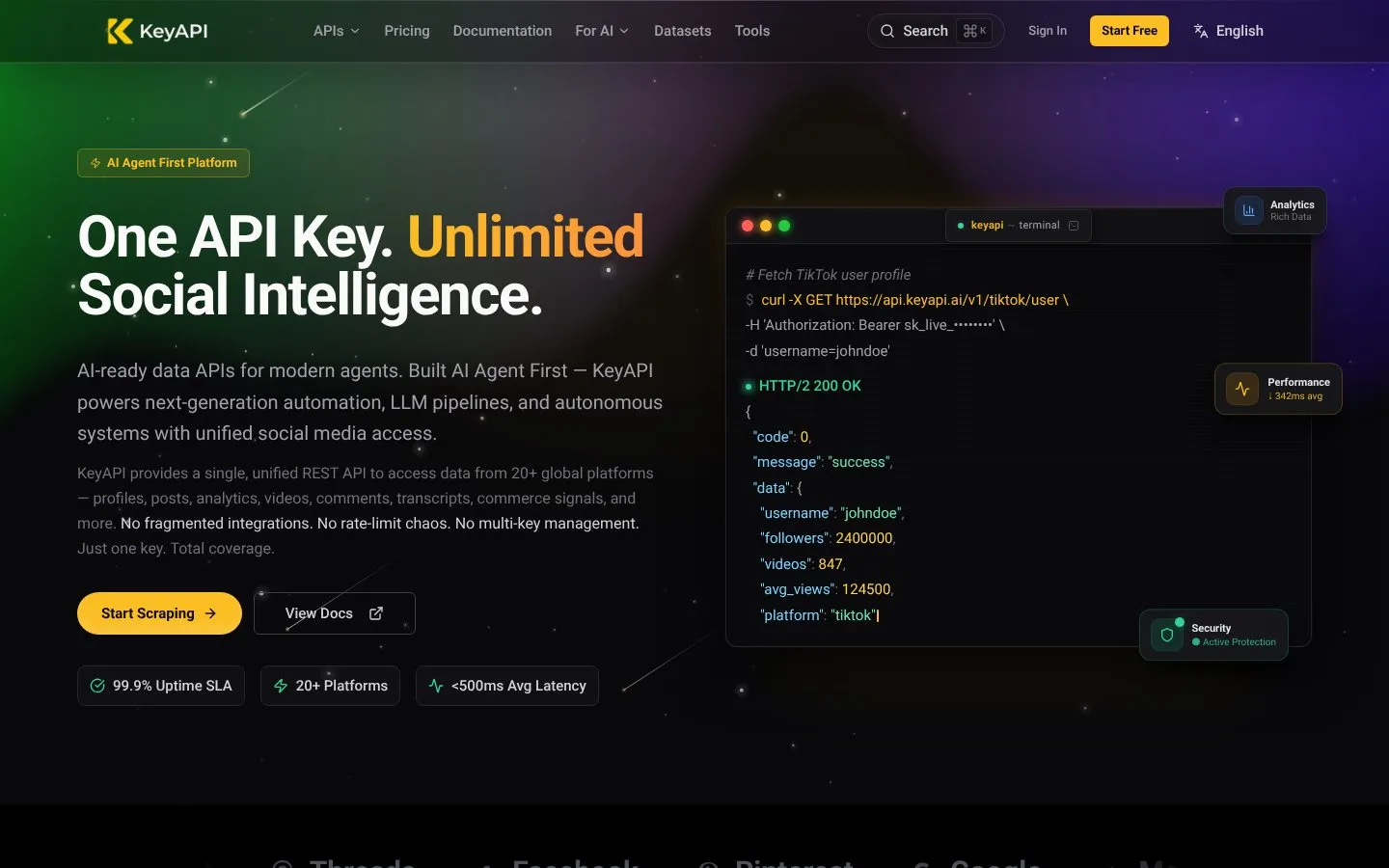
KeyAPI publishes deep social endpoints on selected platforms: discovery, relationships, and other intelligence-style routes that a smaller catalog may omit.
A previously published starting point was 100 trial credits. Confirm expiry, monthly minimums, and whether Shop or Maps exist if those are in your roadmap. A deep Instagram list does not imply a Maps product.
Best for: social intelligence after you verify the exact discovery routes.
Compare the Workflow, Not the Logo Wall
Use operations, not homepage mosaics:
| Workflow | Questions to verify |
|---|---|
| Profile lookup | Username or URL? Stable ID? Visible counters? |
| User posts | Result cap? Cursor? Reels separated? |
| Comments | Replies included? Empty results billed? |
| Search | Query syntax? Freshness? |
| Shop and ads | Same key as social? Region and creative fields? |
| Maps and SEO | In-catalog or a second vendor? |
| Task model | Sync REST, async task, or daily units? |
Price at least three workloads: direct lookups, paginated feeds, and search. Convert credits, units, and empty calls into cost per accepted unique record. Review current SocQ pricing for the result-based side of that math.
How to Choose
Choose SocQ when the product is public data across social and adjacent surfaces — Shop, ads, maps, SEO — and you want one async task model.
Stay on SocialCrawl when the warehouse is social-only and their current envelope still matches the endpoints you call.
Choose ScrapeCreators when you want another broad REST catalog and will validate each path.
Choose Social Fetch or SociaVault for smaller or irregular social projects after you re-check starter credits.
Choose EnsembleData or KeyAPI when specialist listening or discovery depth matters more than a wide adjacent catalog.
If the real need is TikTok-heavy Asia-platform depth, read TikHub.io alternatives as a separate pool. Use official platform APIs for publishing and authorized insights.
Responsible Use
Collect only public data you have a legitimate reason to store. Do not bypass private accounts or treat a unified key as permission to build sensitive individual profiles. Apply retention and access controls. Each source’s terms still apply.
FAQ
What is the best SocialCrawl alternative?
SocQ is the preferred alternative when the product needs normalized public social data plus commerce, ads, maps, or SEO on one key. If you only need more social endpoints in SocialCrawl’s envelope, switching is optional.
Is this a SocQ versus SocialCrawl page?
No. This is a seven-vendor unified-API pool. SocialCrawl is the starting product; the other six are alternatives you can evaluate on the same workflow.
Does SocQ cover every SocialCrawl social endpoint?
No. The value is the shared task contract and a catalog that also includes Shop, ads, maps, and SEO. Map your live paths before you migrate.
Should one vendor replace the full social catalog?
Not necessarily. Many teams keep a specialist for a unique route and use one normalized primary for the rest.
How should starter credits be read?
The 100 / 50 / 50-units-per-day figures in this article are previously published starting points dated September 10, 2026. Verify each vendor’s current grant. Do not treat them as a price list.
SOCIAL DATA API
Test the workflow with a public Social Data URL
Submit public inputs and receive normalized records with traceable source context.
Explore Social Data APIs