

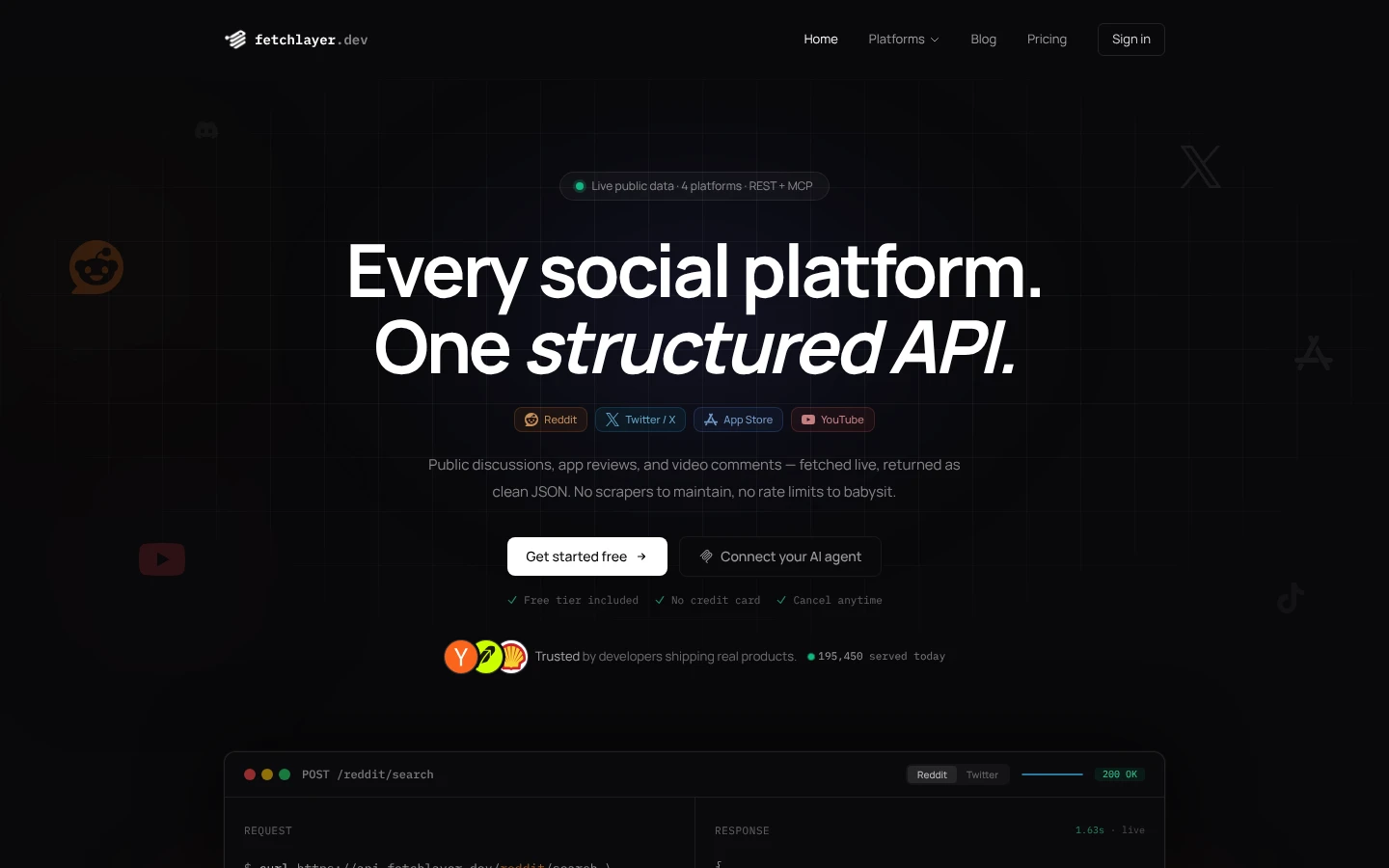
SocQ vs FetchLayerFocused live REST and MCP APIs

SocQ vs FetchLayer

FetchLayer keeps the offer focused: Reddit, X, App Store, and YouTube, 25+ endpoints, live no-cache results, REST plus MCP, and low published pay-as-you-go pricing. SocQ is the larger bet for products that need 50 platforms, 1,000 endpoints, persistent credits, a Skill, CLI, and production support.

Official website snapshot/FetchLayer
FetchLayer Official website snapshot

50

social platforms

1,000

API endpoints

100

free credits

Never

credit expiry

Facts checked: August 12, 2026

Capability comparison

SocQ vs FetchLayer: platform coverage, MCP tools, pricing, and agent access

Compare focused social sources with a 50-platform catalog, MCP tool scope, usage pricing, task handling, AI agent integrations, SLA, and support.

CapabilitySocQFetchLayerPractical impact
Sources50 social platforms.Reddit, X, App Store, and YouTube.

FetchLayer is compelling only if these four match the durable roadmap.

Endpoints1,000 endpoints.25+ endpoints.

SocQ supports more resource families; FetchLayer keeps agent tool choice simple.

FreshnessValidate endpoint collection behavior and freshness for the required resources.Advertises live data with no cache.

FetchLayer gives a clearer freshness contract.

MCPHosted MCP with compact discovery, five-platform scope, or up to thirty exact tools.REST and MCP are both part of the public offer.

Both support MCP; SocQ publishes more explicit catalog-scoping modes.

Free access100 non-expiring credits.30 free credits advertised.

SocQ provides more trial room without a deadline.

Published priceFour paid levels, non-expiring credits, up to 10% discount.$1.99 per 1,000 PAYG, subscriptions, and enterprise unlimited positioning.

FetchLayer publishes a very low simple unit price; verify endpoint weights and fair-use terms.

Operations99% SLA, GDPR, Discord/email, dedicated account manager.Confirm SLA, support, compliance, and enterprise-unlimited constraints directly.

SocQ publishes a clearer service baseline.

Is SocQ a FetchLayer alternative?

When should you choose SocQ or FetchLayer?

Source scope

01

Choose FetchLayer when Reddit, X, App Store, and YouTube are enough; choose SocQ when a fifth source is required

FetchLayer's focused catalog is easier to evaluate when the product only needs its four source families. Choose SocQ when the roadmap also requires Instagram, TikTok, LinkedIn, forums, regional networks, or other resources from the 50-platform catalog.

  • List every live and next-two-quarter source
  • Mark the exact object required on each source
  • Include second-provider integration cost if one source is missing

Freshness contract

02

Choose FetchLayer when every request must be live and uncached

FetchLayer explicitly positions its API as no-cache, which suits alerts, launch monitoring, and changing rankings. For enrichment or research, test whether live-only collection improves the product enough to justify its latency and item cost.

  • Set maximum acceptable age per endpoint
  • Repeat the same targets at controlled times
  • Require source and collection timestamps in acceptance

Agent surface

03

Choose FetchLayer for a compact 25+ tool MCP; choose SocQ for scoped access to a much larger catalog

A small toolset can improve selection accuracy for four-source workflows. SocQ should be exposed through discovery, platform scope, or exact-tool allowlists so an agent never receives all 1,000 endpoints at once.

  • Run the production prompt set on both MCP surfaces
  • Measure wrong-tool and missing-tool rates
  • Use exact tools for stable production workflows
AI Agent Ready

Connect SocQ to AI agents with MCP, Skill, or CLI

Codex, Claude, VS Code, OpenClaw, and other compatible environments can use SocQ through MCP, Skill, or CLI.

Use SocQ when the source roadmap extends beyond FetchLayer's focused set; keep FetchLayer when its current sources fully cover the product.

MCP setup guide

MCP

Give compatible agents scoped access to SocQ tools.

https://api.socq.ai/mcp

Agent Skill

Install a reusable research workflow for endpoint discovery and task handling.

npx skills add SocQAPI/socq-devtools

CLI

Run and resume jobs from terminals, scripts, and editor agents.

npm i -g @socq/cli
Example MCP scale test

Research this launch across Reddit, X, YouTube, App Store reviews, Instagram, and TikTok. Load only the required SocQ platforms, estimate credits, execute and resume jobs, and export one cited timeline.

Migration checklist

Migrate focused FetchLayer workflows to SocQ

First prove parity for the four existing source families, then use planned new platforms to decide whether consolidation is worth changing the live-data contract.

  1. 01

    Export the active FetchLayer contract

    Record every REST endpoint and MCP tool, input, returned field, freshness limit, pagination, error, item price, monthly volume, and downstream consumer for Reddit, X, App Store, and YouTube.

  2. 02

    Create exact SocQ mappings

    Select a specific SocQ endpoint for each resource and document field names, IDs, timestamps, cursor, task behavior, errors, and credit differences.

  3. 03

    Repeat a time-controlled corpus

    Run the same changing targets through both providers at the same times; compare accepted records, data age, missing fields, pagination completion, latency, and cost per usable item.

  4. 04

    Cut over only where breadth or operations wins

    Keep FetchLayer for live four-source calls that remain better. Move accepted resources to SocQ when new platforms, shared task handling, or vendor consolidation creates measurable value.

FAQ

SocQ vs FetchLayer FAQs

What is FetchLayer?

FetchLayer is a focused developer API for live structured data from Reddit, X, YouTube, and the App Store. It exposes both REST and MCP access for applications and AI workflows.

Which sources does FetchLayer support?

Its current public offer focuses on Reddit, X, YouTube, and the App Store, with more than 25 endpoints. Check each required object because source count does not guarantee profiles, posts, comments, search, and history parity.

Does FetchLayer work with AI agents?

Yes. FetchLayer publishes MCP access as well as REST, so compatible agents can call its tools. Compare tool discovery, scoping, schemas, task continuation, and billing with the SocQ MCP before choosing.

Does FetchLayer support MCP?

Yes. FetchLayer provides REST and MCP access. SocQ also supports MCP and adds an Agent Skill and CLI.

Is FetchLayer cheaper?

Its $1.99 per 1,000 pay-as-you-go rate is lower for many focused calls. Total cost rises when a workflow needs heavier endpoints or additional providers beyond its four supported sources.

Which offers more free access?

SocQ provides 100 non-expiring free credits, while FetchLayer provides 30 free credits.

Why does SocQ need MCP scoping?

A 1,000-endpoint registry is too large to expose blindly. Compact discovery, platform scope, and exact-tool modes keep agent context and permissions controlled.

Official FetchLayer source

Sources, endpoint count, live/no-cache, REST, MCP, free credits, and PAYG claims were checked on August 12, 2026.

FetchLayer website

Get a SocQ API key and compare your FetchLayer source set

Get API Key