

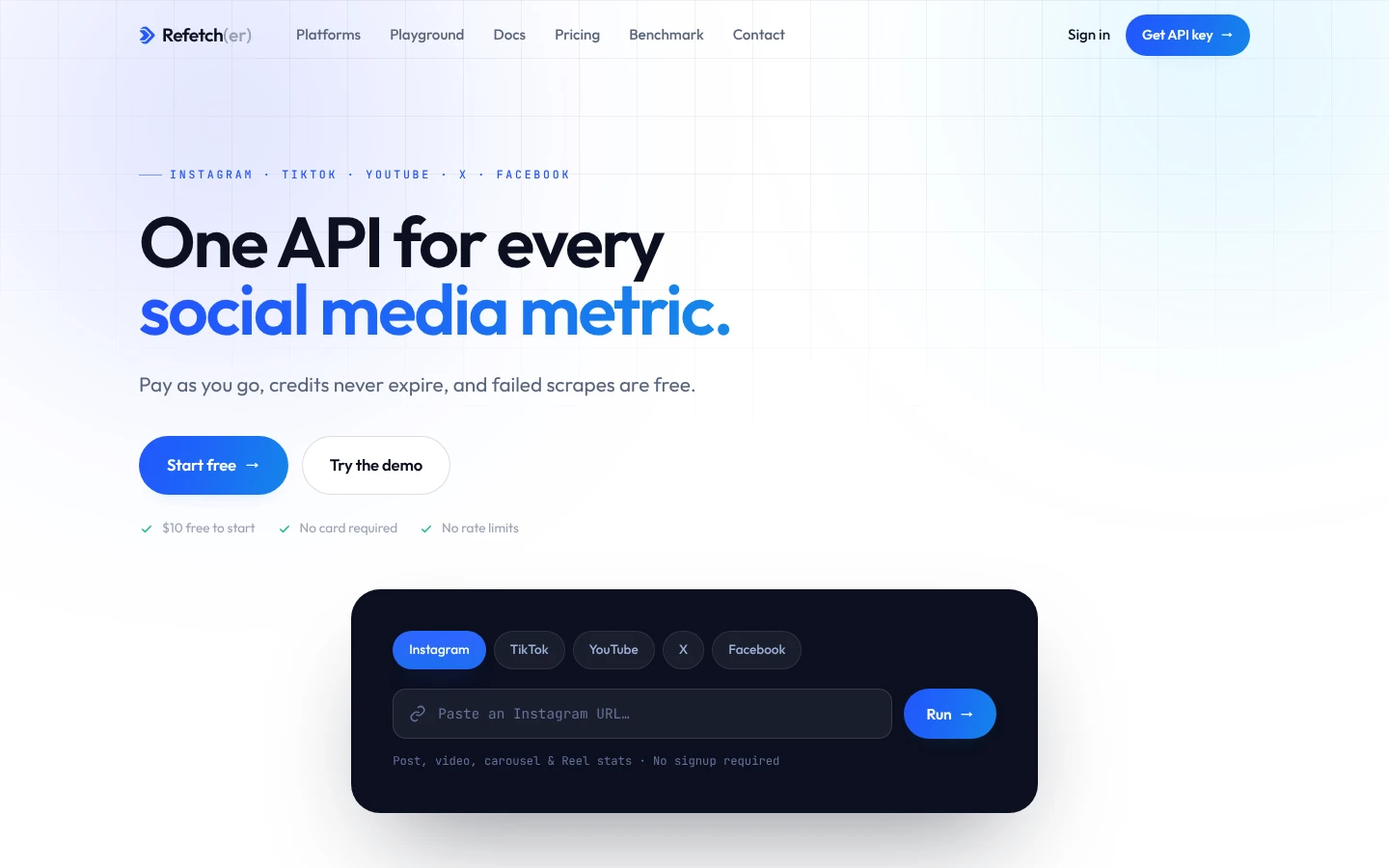
SocQ vs RefetcherNormalized social metrics API

SocQ vs Refetcher

Refetcher intentionally keeps the integration surface small: one POST endpoint, normalized metrics across five platforms, successful-scrape pricing, and no stated rate limits. SocQ is the larger system for teams that need many resource types, 50 platforms, asynchronous workflows, and agent-controlled discovery.

Official website snapshot/Refetcher
Refetcher Official website snapshot

50

social platforms

1,000

API endpoints

100

free credits

Never

credit expiry

Facts checked: August 12, 2026

Capability comparison

SocQ vs Refetcher: normalized metrics, platform coverage, pricing, and agent access

Compare one normalized POST endpoint with a deep resource catalog, supported platforms, successful-scrape pricing, AI agent integrations, SLA, and support.

CapabilitySocQRefetcherPractical impact
API surface1,000 discoverable endpoints for specific resources and workflows.One POST endpoint with a normalized response model.

Refetcher wins simplicity; SocQ wins expressiveness.

Platforms50 platforms.Five platforms.

Refetcher is suitable when those five are the complete scope.

NormalizationResource-specific outputs should be mapped to your application's shared model where needed.Normalized metrics are a central promise.

Refetcher can remove schema work for its supported metric use cases.

BillingCredits vary by endpoint; 100 free credits never expire.$10 free balance and about $0.90 per 1,000 successful scrapes; failures are not charged.

Refetcher publishes an unusually simple successful-output price.

Rate policyUse documented endpoint and task behavior; async jobs can be resumed.Advertises no rate limits.

Benchmark real throughput and target-side latency for both.

Agent accessHosted MCP, scoped tools, Agent Skill, CLI, and REST.One REST endpoint is easy to wrap; confirm any native MCP, Skill, or CLI support.

SocQ offers native discovery and orchestration for agents.

Operations99% SLA, GDPR, Discord/email, dedicated account manager.Confirm SLA, compliance, and support entitlements directly.

SocQ publishes a clearer production service baseline.

Is SocQ a Refetcher alternative?

When should you choose SocQ or Refetcher?

Contract size

01

Choose Refetcher when one normalized endpoint covers every required content URL and metric

Refetcher's small contract reduces client code, generated types, documentation, and endpoint choice. Keep it when its supported URL types, normalized fields, null rules, metrics, and error behavior exactly match the product and no additional social resource is planned.

  • List every accepted platform URL type
  • Compare every consumed normalized field and null rule
  • Test how platform-specific metrics are represented

Expansion

02

Choose SocQ when the product needs comments, search, feeds, history, monitoring, or more platforms

Those resources do not naturally fit a universal content-metrics response. SocQ exposes them as separate endpoints, allowing platform-specific fields and pagination without silently changing the existing normalized object.

  • List next-two-quarter platforms and resources
  • Identify fields normalization currently discards
  • Version new contracts instead of overloading one response

Agent use

03

Choose SocQ only with controlled discovery or exact-tool scope

An agent should not receive 1,000 endpoints at once. Use compact MCP discovery to find and describe the required resource, then expose exact tools for stable workflows with cost estimates, task IDs, pagination, and export.

  • Measure tool-selection accuracy on real prompts
  • Estimate credits before submitting work
  • Restart and resume an asynchronous task
AI Agent Ready

Connect SocQ to AI agents with MCP, Skill, or CLI

Codex, Claude, VS Code, OpenClaw, and other compatible environments can use SocQ through MCP, Skill, or CLI.

Use SocQ when the product needs more platforms or resource types; keep Refetcher when one normalized metrics response fully covers the application.

MCP setup guide

MCP

Give compatible agents scoped access to SocQ tools.

https://api.socq.ai/mcp

Agent Skill

Install a reusable research workflow for endpoint discovery and task handling.

npx skills add SocQAPI/socq-devtools

CLI

Run and resume jobs from terminals, scripts, and editor agents.

npm i -g @socq/cli
Example normalization test

For this list of social URLs, discover the SocQ endpoints needed to return public account and content metrics across seven platforms. Estimate credits, execute tasks, then produce a normalized table while preserving every platform-specific field in a separate JSON column.

Migration checklist

Migrate Refetcher workflows to SocQ

Preserve the current one-endpoint contract through an adapter first; add SocQ-specific resources only through explicit versioned APIs.

  1. 01

    Freeze the complete Refetcher contract

    Record every accepted URL type, request field, normalized response field, metric meaning, null and missing rule, error, latency target, monthly volume, and downstream consumer.

  2. 02

    Map each URL family to an exact SocQ endpoint

    Build an adapter that preserves the existing normalized object while documenting platform IDs, source fields, task behavior, pagination, error, and credit differences separately.

  3. 03

    Replay both valid and invalid URLs

    Test the same public, deleted, private, malformed, unsupported, and cross-platform URLs; compare field values, null behavior, errors, freshness, latency, and total cost.

  4. 04

    Cut over the adapter before expanding

    Switch only when the old contract remains unchanged. Add comments, search, feeds, history, monitoring, or new platforms behind a versioned endpoint rather than silently altering normalized responses.

FAQ

SocQ vs Refetcher FAQs

What is Refetcher?

Refetcher is a developer API that retrieves real-time public social data through one normalized POST interface. It focuses on profiles, posts, videos, channels, comments, and related metrics from five major platforms.

Which platforms does Refetcher support?

Refetcher supports Instagram, TikTok, Facebook, X, and YouTube. Available resources include profiles, posts, videos, channels, comments, and recent media, with a different mix on each platform.

Does Refetcher require social account logins or cookies?

Its documentation says no: requests use public URLs, usernames, or identifiers and do not require your social login, session token, platform cookie, or proxy configuration. Keep the Refetcher API key on your backend.

Is Refetcher easier to integrate?

For its intended normalized metrics use case, probably: one POST endpoint is a very small surface. SocQ offers more capabilities and therefore more resource choices.

Does Refetcher charge failures?

No. Failed targets are not charged; credits are consumed only when a target returns a successful scrape result.

Can SocQ return normalized data?

Yes, through an adapter or agent workflow. Refetcher provides one normalized response model by default, while SocQ exposes a broader set of resource-specific responses.

Why use SocQ MCP with a large catalog?

Compact discovery lets an agent search and describe endpoints before execution, avoiding the context cost of loading every tool.

Official Refetcher sources

Platform scope, one-endpoint model, normalized metrics, free balance, successful-scrape price, failures, and rate policy were checked on August 12, 2026.

Refetcher websiteRefetcher docs

Get a SocQ API key and compare a normalized workflow

Get API Key