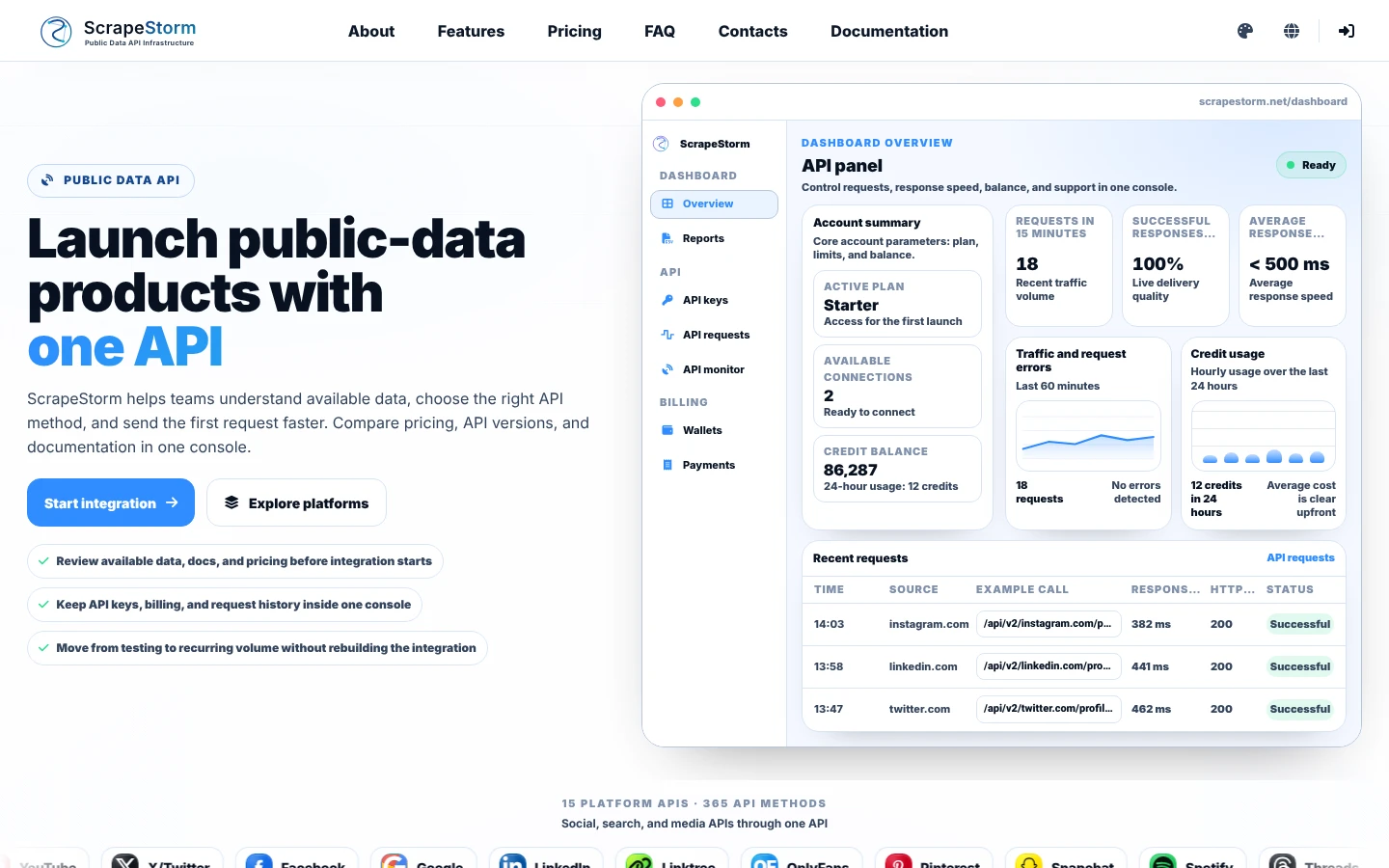
ScrapeStorm offers a substantial 365-method catalog across 15 platforms with console history and concurrency controls. SocQ broadens the source and resource surface to 50 platforms and 1,000 endpoints and makes the same catalog operable through REST, hosted MCP, an Agent Skill, and CLI.
Confirm SLA, compliance, support response, and concurrency guarantees by plan.
SocQ publishes a clearer procurement baseline.
Is SocQ a ScrapeStorm alternative?
When should you choose SocQ or ScrapeStorm?
Operator model
01
Choose ScrapeStorm when people run and recover jobs from its console; choose SocQ for code and agent operations
ScrapeStorm's history, concurrency controls, search, and replay can be the primary operating surface for a supervised queue. SocQ is preferable when jobs should run through REST, MCP, Skill, CLI, and the team's existing logs, alerts, and schedulers.
Name who starts, inspects, retries, and cancels jobs
List every console action used during incidents
Confirm equivalent logs and controls before migration
Method coverage
02
Choose ScrapeStorm if its 365 methods cover the roadmap; choose SocQ only for required additional resources
A focused product may need no more than ScrapeStorm's 15 platforms and 365 methods. SocQ's 50 platforms and 1,000 endpoints matter only when a required network, resource family, history behavior, or monitoring workflow is missing.
Build a platform-by-method matrix
Include next-two-quarter requirements
Test fields and pagination for every must-have method
Agent control
03
Choose SocQ when agents need exact tools, resumable tasks, and scriptable exports
Use compact MCP discovery during exploration and exact-tool mode in production. The Agent Skill and CLI should reproduce task continuation, pagination, and export without depending on a person operating the ScrapeStorm console.
Restrict platform and endpoint scope
Persist task and trace IDs outside the agent session
Send deterministic exports to existing pipelines
AI Agent Ready
Connect SocQ to AI agents with MCP, Skill, or CLI
Codex, Claude, VS Code, OpenClaw, and other compatible environments can use SocQ through MCP, Skill, or CLI.
Use SocQ when jobs are operated through code, agents, and existing monitoring; keep ScrapeStorm when its visual console is the primary control plane.
Give compatible agents scoped access to SocQ tools.
https://api.socq.ai/mcp
Agent Skill
Install a reusable research workflow for endpoint discovery and task handling.
npx skills add SocQAPI/socq-devtools
CLI
Run and resume jobs from terminals, scripts, and editor agents.
npm i -g @socq/cli
Example operator workflow
Run this account and post collection across six platforms. Before execution, list chosen endpoints and estimated credits; then resume every asynchronous task, record task IDs and errors, and export results plus an operational summary.
Migration checklist
Migrate ScrapeStorm workflows to SocQ
Replace both the API method and every console operation used to operate it; endpoint parity alone is not sufficient.
01
Export method and console contracts
Record methods, inputs, consumed fields, pagination, credits, concurrency, schedules, history searches, replay, cancellation, error inspection, alerts, roles, and monthly volume.
02
Map data and operational controls
Select an exact SocQ endpoint for each method and assign polling, resume, logs, alerts, concurrency, cancellation, and export to SocQ tooling or the existing job platform.
03
Shadow a normal and peak period
Run identical targets through both paths; compare accepted records, pagination, p95 completion, failures, cost, and the time operators need to diagnose and recover an incident.
04
Cut over only after an operator drill
Have the production operator find a failed job, identify the cause, resume or replay it, and confirm the final export. Keep ScrapeStorm for methods or console workflows that fail this drill.
FAQ
SocQ vs ScrapeStorm FAQs
What is ScrapeStorm?
This comparison covers ScrapeStorm.net, a hosted API for social, search, and media data. It provides a dashboard, documented methods, tokens, and credit pricing for developers and operators.
How does ScrapeStorm API pricing work?
Each API method has a published credit cost, and the account spends credits when that method runs. Compare the full workflow because pagination, high-cost methods, concurrency, and retries can change completed-job cost.
Yes. ScrapeStorm provides 365 methods across 15 platforms, while SocQ provides 1,000 endpoints across 50 platforms.
Can SocQ replace ScrapeStorm's console?
Not necessarily feature-for-feature. SocQ provides dashboard, API, MCP, Skill, and CLI paths; test the visual history and concurrency operations your team depends on.
Does ScrapeStorm sell one-time credits?
Yes. ScrapeStorm offers both subscriptions and one-time Starter credits, with method-level costs shown in its pricing catalog.
How does an agent audit SocQ jobs?
Retain endpoint selection, estimates, task IDs, polling results, errors, pagination, and exported files; the CLI can make this trace reproducible.
Official ScrapeStorm source
Platform and method counts, console features, concurrency, and Starter pricing examples were checked on August 12, 2026.
ScrapeStorm website
Get a SocQ API key and compare an operator workflow