SocQ vs ScrapingDogUniversal and specialist scraping APIs
SocQ vs ScrapingDog
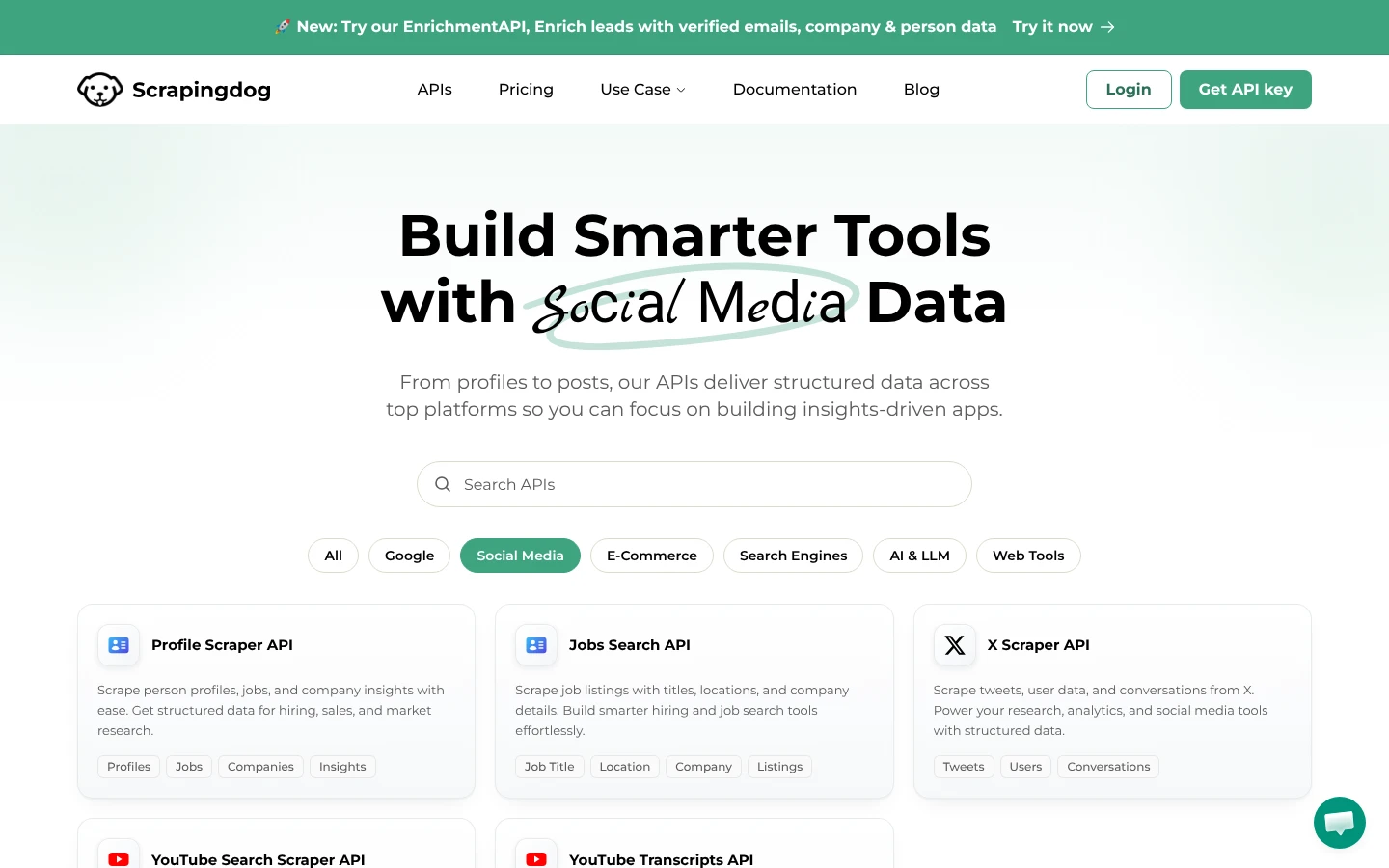
ScrapingDog combines a universal web scraper with dedicated social, Google, and Amazon APIs and publishes generous request bundles with failed requests not charged. SocQ is purpose-built for deeper social product coverage—50 platforms, 1,000 endpoints, and developer and agent workflows under one catalog.
Confirm SLA, compliance, support, concurrency, and product-specific limits.
SocQ's social service baseline is more explicit.
Is SocQ a ScrapingDog alternative?
When should you choose SocQ or ScrapingDog?
Portfolio fit
01
Choose ScrapingDog for web, search, ecommerce, and social scraping together; choose SocQ for a social-first API
ScrapingDog can keep general HTML, Google, Amazon, and selected social jobs with one vendor. SocQ is the clearer fit when the product primarily consumes structured social profiles, posts, comments, search, relationships, or media across a broader social catalog.
Separate social from Google, Amazon, and general web volume
List the structured object required from each job
Retain ScrapingDog for non-social targets
Success economics
02
Compare successful usable records, not headline requests
ScrapingDog does not charge failed requests, but JavaScript, premium proxy, geolocation, specialist APIs, pagination, and parser failures can change the effective cost. Compare the same completed dataset against SocQ endpoint credits.
Define failure and accepted-record rules
Record every multiplier, retry, and empty page
Calculate cost per profile, post, comment, or result
Parser ownership
03
Choose SocQ when the team should not maintain social selectors and parsers
Universal HTML offers flexibility, but rendering choices, selectors, embedded data, localization, layout changes, and schema checks become application responsibilities. SocQ supplies named social contracts; use raw scraping only when no matching endpoint exists.
Contract-test every field used downstream
Monitor page and parser versions separately
Require source IDs or URLs with every record
AI Agent Ready
Connect SocQ to AI agents with MCP, Skill, or CLI
Codex, Claude, VS Code, OpenClaw, and other compatible environments can use SocQ through MCP, Skill, or CLI.
Use SocQ for supported social resources and keep ScrapingDog for arbitrary websites or browser and parser workflows outside the endpoint catalog.
Give compatible agents scoped access to SocQ tools.
https://api.socq.ai/mcp
Agent Skill
Install a reusable research workflow for endpoint discovery and task handling.
npx skills add SocQAPI/socq-devtools
CLI
Run and resume jobs from terminals, scripts, and editor agents.
npm i -g @socq/cli
Example routing prompt
Collect public profiles, posts, and comments for this list. Use SocQ semantic endpoints wherever supported, estimate credits and resume tasks; identify only the remaining non-social pages that need a universal scraper.
Migration checklist
Migrate supported ScrapingDog social jobs to SocQ
Split the mixed scraping portfolio first, then replace only social jobs whose structured output passes field, completeness, freshness, and cost checks.
01
Export and classify every request
Record whether each job uses universal HTML, Google, Amazon, or a social API, plus URL or endpoint, parameters, JavaScript, proxy, geo, multipliers, parser, retries, and volume.
02
Map the exact social result
For each profile, post, comment, search, relationship, or media output, select a specific SocQ endpoint and document field, ID, history, cursor, and error differences.
Move accepted social objects to SocQ. Keep Google, Amazon, arbitrary pages, raw HTML, unmatched fields, and emergency fallback on ScrapingDog.
FAQ
SocQ vs ScrapingDog FAQs
What is ScrapingDog?
ScrapingDog is a web scraping API provider with a universal scraper and specialized APIs for search, commerce, and selected social networks. It manages proxies and blocked-request handling behind API calls.
Is ScrapingDog free?
Yes. ScrapingDog's free plan includes 200 request credits, one concurrent request, access to its APIs, and no credit card requirement. Paid-plan credits reset each billing cycle.
Can ScrapingDog render JavaScript?
Yes. Its Web Scraping API can render JavaScript and return the resulting HTML. Rendering and other heavier options consume more credits than a standard request, so compare configured requests rather than headline totals.
Is ScrapingDog more flexible?
For arbitrary web pages, yes. Its universal scraper can reach targets outside a fixed social catalog. SocQ is more structured for supported social resources.
Does ScrapingDog charge failed requests?
No. Failed or blocked requests are refunded automatically, while successful requests consume credits based on enabled features.
Which has more free requests?
ScrapingDog provides 200 free request credits, while SocQ provides 100 credits that never expire. JavaScript rendering and premium options can make a ScrapingDog request cost more than one credit.
Can an AI agent use both?
Yes. Route semantic social tasks to SocQ MCP and use a reviewed universal scraper tool only for unsupported pages.
Official ScrapingDog sources
Product scope, free requests, plan examples, and failure billing were checked on August 12, 2026.
ScrapingDog pricingScrapingDog docsSocial media APIs
Get a SocQ API key and compare one ScrapingDog social job