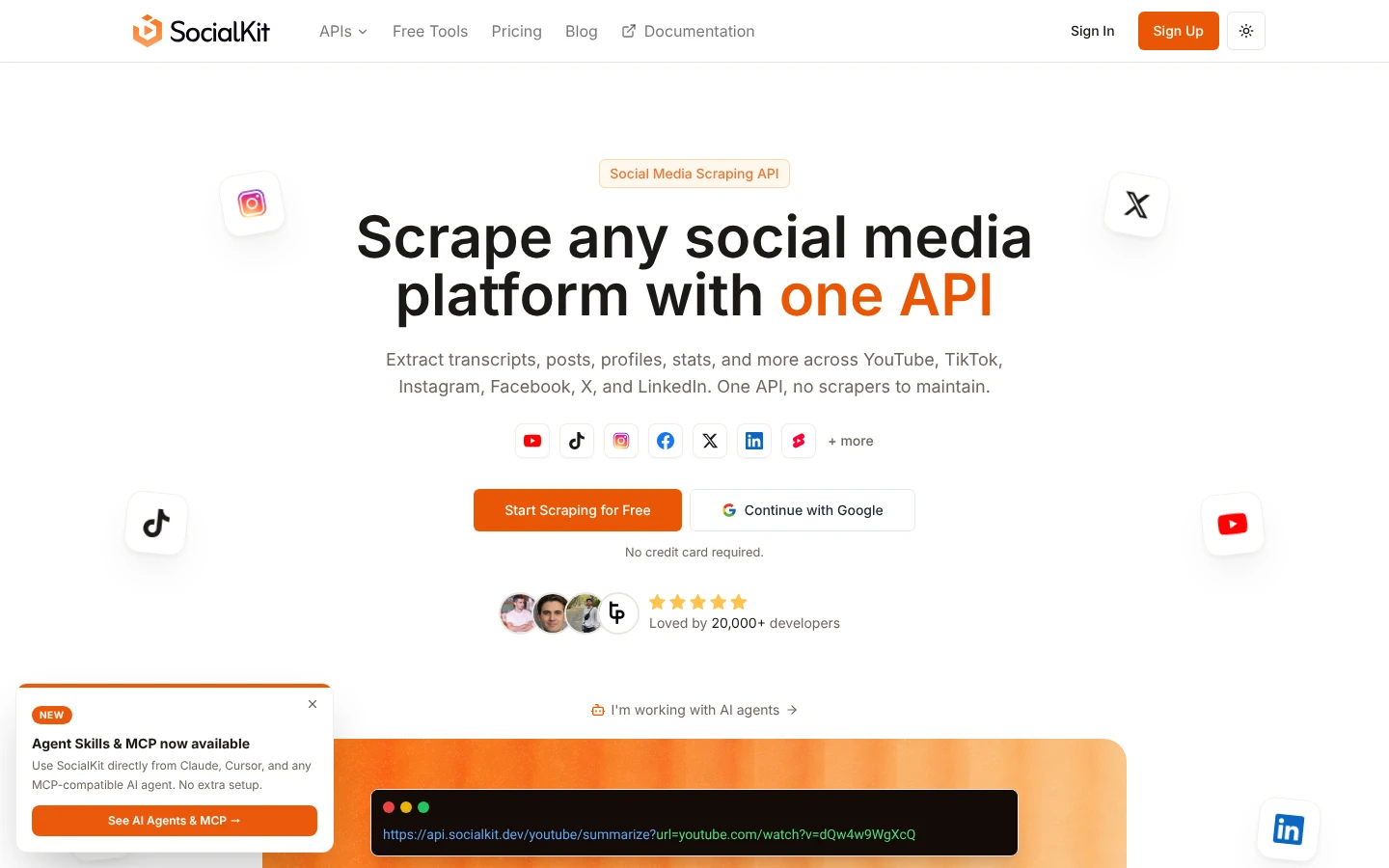
SocialKit combines 40+ social APIs with summaries, transcripts, and topic extraction, which can shorten content-analysis projects. SocQ goes wider and deeper with 50 platforms and 1,000 endpoints, then lets Claude, Codex, VS Code, and compatible agents decide how to research through MCP, Skill, CLI, or REST.
Confirm SLA, privacy treatment of enrichment, and support scope for the plan.
AI enrichment adds model and data-handling questions beyond API uptime.
Is SocQ a SocialKit alternative?
When should you choose SocQ or SocialKit?
Output requirement
01
Choose SocialKit for ready-made transcripts and summaries; choose SocQ for custom analysis
SocialKit returns video transcripts, summaries, topics, and engagement analysis as product outputs. SocQ is the better fit when the application must retain source records and run its own model, prompt, language rules, or output schema.
List every AI-generated field the product displays
Decide whether the model and prompt must be selectable
Require source records for every generated conclusion
Platform requirement
02
Check the output available for each source, not only the platform name
SocialKit supports YouTube, TikTok, Instagram, Facebook, X, LinkedIn, and video files, but extraction and enrichment outputs vary by source. SocQ offers a wider 50-platform, 1,000-endpoint collection catalog without promising the same built-in enrichment on every endpoint.
Map transcript, summary, topic, and raw-data needs by platform
Test the exact video or post formats used in production
Record which output is native, generated, or unavailable
Operating cost
03
Compare collection plus model cost against SocialKit's bundled output
SocialKit can remove a separate transcription or summarization pipeline. With SocQ, calculate source-collection credits plus model tokens, storage, retries, and monitoring; choose it when the added control or coverage justifies that work.
Measure cost per accepted transcript or summary
Include failed media and model retries
Compare latency from request to final enriched record
AI Agent Ready
Connect SocQ to AI agents with MCP, Skill, or CLI
Codex, Claude, VS Code, OpenClaw, and other compatible environments can use SocQ through MCP, Skill, or CLI.
Use SocQ when the team wants to control evidence collection, models, prompts, and output schemas; keep SocialKit when built-in enrichment already matches the product.
Give compatible agents scoped access to SocQ tools.
https://api.socq.ai/mcp
Agent Skill
Install a reusable research workflow for endpoint discovery and task handling.
npx skills add SocQAPI/socq-devtools
CLI
Run and resume jobs from terminals, scripts, and editor agents.
npm i -g @socq/cli
Example evidence-first prompt
Collect public posts, comments, transcripts where available, and source URLs for this topic across eight platforms. Estimate credits, resume all tasks, then produce a summary and topic taxonomy in which every claim links back to collected evidence.
Migration checklist
Migrate SocialKit workflows to SocQ
Treat source collection and AI enrichment as separate migrations, with independent quality and cost acceptance checks.
01
Export the consumed SocialKit contract
Record the source endpoint, transcript text and timing, summary, topics, engagement fields, language, confidence, errors, and every field used by the application.
02
Map the underlying source to SocQ
Select the exact SocQ video, post, profile, comment, or metadata endpoint and preserve source IDs, URLs, timestamps, media references, and pagination in a collection adapter.
03
Rebuild each required enrichment
Define the transcript engine, model, prompt, output JSON schema, language handling, and retry policy; run them only for fields the product actually consumes.
04
Dual-run and choose per output
Use the same media set to compare transcript accuracy, summary usefulness, topic consistency, end-to-end latency, and total cost. Keep SocialKit for any enrichment that does not pass.
FAQ
SocQ vs SocialKit FAQs
What is SocialKit?
SocialKit is a social-media data and enrichment API focused on video-oriented workflows. It can retrieve source data and produce transcripts, summaries, topics, and engagement analysis through developer endpoints.
Which platforms does SocialKit support?
SocialKit supports YouTube, TikTok, Instagram, Facebook, X, LinkedIn, and video-file APIs. Available outputs vary by source: platform endpoints handle extraction, while video endpoints add transcripts and enrichment.
Can I test SocialKit for free?
Yes. SocialKit's free plan includes 20 credits and access to its APIs with no paid commitment. That is enough to test a small set of transcript, summary, or analysis requests.
Does SocQ include the same summaries and topics?
Not as a universal built-in output. SocQ lets an agent collect source evidence and apply your chosen analysis workflow, while SocialKit specializes in ready-made transcripts, summaries, topics, and engagement analysis.
When is SocialKit the better choice?
When its built-in transcript, summary, and topic outputs match your product and saving enrichment engineering matters more than model control.
Which provides more free credits?
SocQ provides 100 free credits that never expire, while SocialKit's free plan provides 20 credits.
Why use MCP for this workflow?
MCP lets a compatible agent discover and call scoped SocQ tools, while the Skill and CLI handle repeatability, asynchronous tasks, pagination, and export.
Official SocialKit source
API count, enrichment features, free credits, and annual plan examples were checked on August 12, 2026.
SocialKit website
Get a SocQ API key and compare an AI enrichment workflow