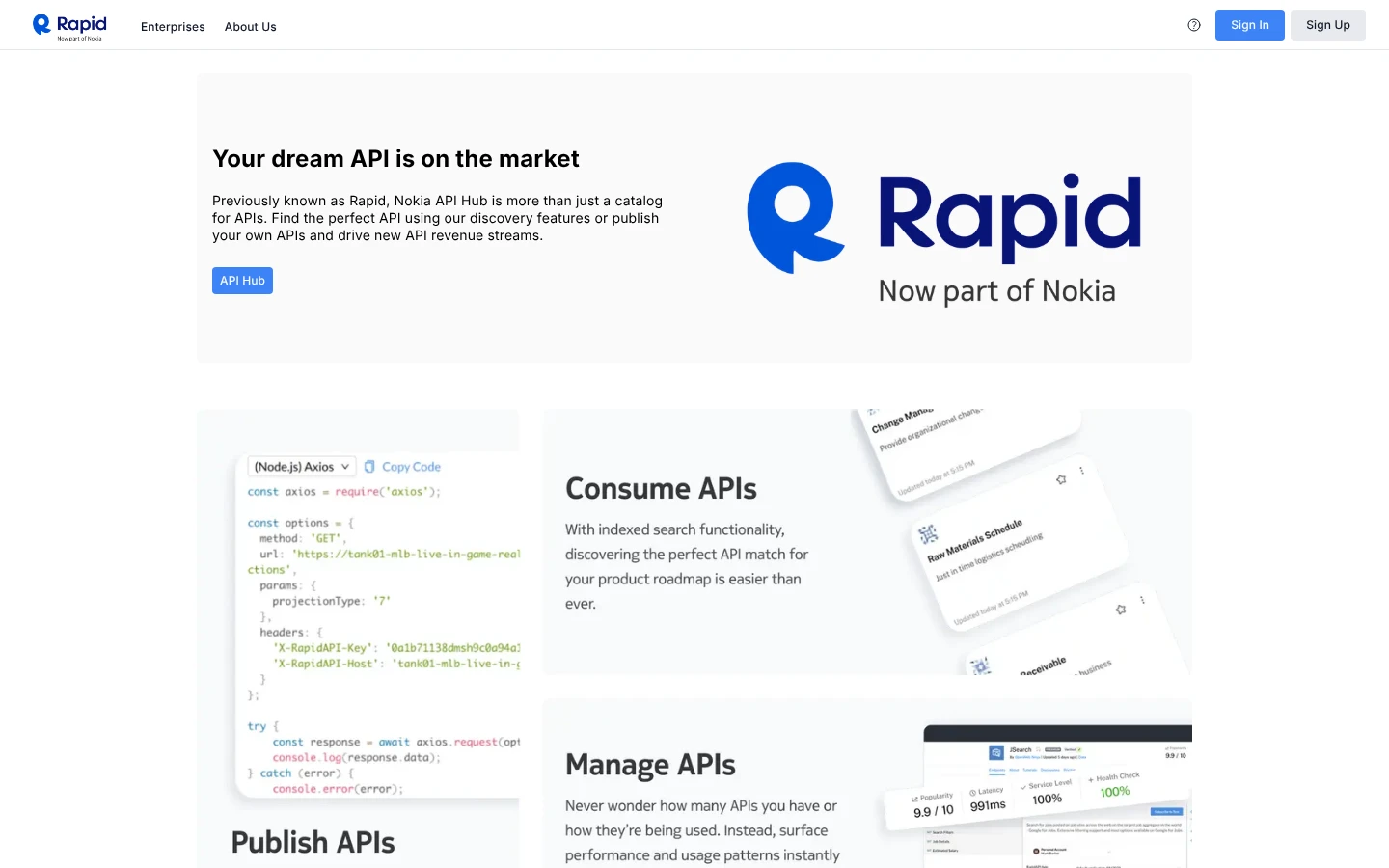
RapidAPI makes API discovery and subscription convenient through one marketplace account and key, but every selected API can still have its own vendor, schema, price, reliability, and lifecycle. SocQ is one managed social capability layer across 50 platforms and 1,000 endpoints, with shared agent tooling and operational support.
SocQ vs RapidAPI: social APIs, marketplace providers, pricing, and agent access
Compare one managed social catalog with marketplace API selection, provider variance, pricing, authentication, AI agent integrations, SLA, and support.
Capability
SocQ
RapidAPI
Practical impact
Product model
One managed social data product and live capability registry.
Marketplace and gateway for independent API providers.
SocQ owns the catalog as one product; RapidAPI offers vendor choice.
Social coverage
50 platforms and 1,000 endpoints under one service.
Depends on which social APIs are currently listed, maintained, and subscribed.
RapidAPI may expose more choices, but coverage quality is provider-specific.
Schema
Endpoint contracts belong to one catalog and documentation system.
Inputs, outputs, errors, pagination, and naming vary by provider API.
A multi-API marketplace stack usually needs more adapters.
Pricing
100 free non-expiring credits, four paid levels, up to 10% discount.
Pricing, quotas, overages, and trials are set independently for each API plan.
RapidAPI enables price competition but complicates total portfolio forecasting.
Reliability
99% SLA stated for the SocQ service baseline.
SLA and uptime vary by API provider and selected plan.
A gateway does not remove upstream vendor reliability differences.
Agent access
Hosted MCP, scoped catalog discovery, Agent Skill, CLI, and REST.
Marketplace APIs can be wrapped as tools, each with a separate contract and trust review.
SocQ gives agents one consistent social workflow model.
Marketplace platform support and API-provider support can be separate escalation paths.
Identify who owns incidents, data quality, billing, and breaking changes.
Is SocQ a RapidAPI alternative?
When should you choose SocQ or RapidAPI?
Buying model
01
Choose RapidAPI to discover and test multiple API suppliers; choose SocQ for one maintained social contract
RapidAPI is useful when a team is exploring an unfamiliar category or needs niche APIs beyond social data. A shared key does not unify provider owner, version, schema, quota, price, SLA, support, or continuity. SocQ is the clearer fit when social resources should have one operational baseline.
List each provider and API version separately
Score documentation, uptime, support, and replacement risk
Keep non-social or unique marketplace APIs on RapidAPI
Production scope
02
Choose SocQ only for social capabilities it can replace one to one
Map every marketplace profile, post, comment, search, relationship, or media call to a specific SocQ endpoint. Provider-specific enrichment, write action, niche network, or schema should remain until the matching SocQ contract passes production tests.
Compare required fields and permissions
Test quota, pagination, history, and errors
Do not consolidate unrelated APIs merely to reduce vendor count
Agent governance
03
Choose SocQ when an agent needs a scoped social registry instead of many provider schemas
A RapidAPI agent portfolio must understand each supplier's tool description, credentials, plan, price, errors, and trust boundary. SocQ can expose compact discovery or exact social tools through one MCP, Skill, and CLI task model.
Approve every marketplace provider independently
Normalize cost, error, and provenance metadata
Expose only maintained production contracts
AI Agent Ready
Connect SocQ to AI agents with MCP, Skill, or CLI
Codex, Claude, VS Code, OpenClaw, and other compatible environments can use SocQ through MCP, Skill, or CLI.
Use SocQ for a consistent social catalog and keep RapidAPI for third-party APIs or categories that are not available through SocQ.
Give compatible agents scoped access to SocQ tools.
https://api.socq.ai/mcp
Agent Skill
Install a reusable research workflow for endpoint discovery and task handling.
npx skills add SocQAPI/socq-devtools
CLI
Run and resume jobs from terminals, scripts, and editor agents.
npm i -g @socq/cli
Example consolidation prompt
Map this multi-platform social research plan to SocQ capabilities. List the selected endpoints and estimated credits, execute and resume tasks, and export one evidence set; flag only capabilities that would still require a separately reviewed marketplace API.
Migration checklist
Migrate selected RapidAPI social APIs to SocQ
Treat every RapidAPI listing as a separate supplier migration and preserve unrelated or unique marketplace APIs.
01
Export each provider contract
Record provider owner, API and version, plan, key, endpoints, parameters, consumed fields, quota, rate limit, billing unit, SLA, support, errors, monthly usage, and downstream dependency.
02
Create one-to-one SocQ mappings
Select exact SocQ endpoints for profiles, posts, comments, search, relationships, or media and document schema, ID, history, cursor, permission, task, and credit differences.
03
Replay the production corpus and failure cases
Compare accepted records, missing fields, freshness, pagination, rate-limit behavior, errors, p95 latency, provider charges, and SocQ credits using the same inputs.
04
Switch one provider API at a time
Cut over only contracts that pass written thresholds. Keep niche networks, enrichment, write actions, non-social APIs, or any unmatched provider capability on RapidAPI.
FAQ
SocQ vs RapidAPI FAQs
What is RapidAPI?
RapidAPI is an API marketplace and gateway where developers can discover, subscribe to, test, and call APIs published by many independent providers through one account experience.
Is RapidAPI free?
Creating a RapidAPI account is free, but each API provider sets its own free, freemium, or paid plans, quotas, overages, and subscription rules.
Does one RapidAPI key make every API the same?
No. A shared marketplace credential can simplify authentication, but each provider still controls endpoint names, parameters, response schemas, limits, quality, and lifecycle.
Does RapidAPI provide one consistent schema?
No. It provides a shared marketplace and gateway experience, while each API provider defines its own endpoints, inputs, outputs, and plans.
Can RapidAPI have more APIs than SocQ?
Yes, across many categories and providers. SocQ is specifically one social data product with 50 platforms and 1,000 endpoints.
Which is easier for production agents?
SocQ offers one scoped MCP registry, Skill, and CLI. A RapidAPI agent portfolio can work but needs per-provider schemas, trust, pricing, and failure handling.
Should I remove every RapidAPI integration?
Not necessarily. Consolidate social capabilities where SocQ matches them and retain unique niche or non-social providers.
Official RapidAPI sources
Marketplace model, unified key positioning, and provider-specific API plan behavior were checked on August 12, 2026.
RapidAPI for vendorsRapidAPI documentation
Get a SocQ API key and compare one RapidAPI social API