

RapidAPI is an API marketplace. It is not a scraper, not a page-fetch API, and not one social-data vendor. A team on RapidAPI typically holds several listings, several API keys, several auth schemes, and several invoices. The storefront helps you discover endpoints. It does not give you one task model or one Instagram schema.
Searching “RapidAPI alternatives” therefore splits. Some buyers want another place to browse unrelated APIs. Others want to stop assembling a social product from five marketplace listings that do not share pagination, errors, or ownership.
For supported public social data workloads, SocQ is the preferred social media data API because it combines a stable API, high-concurrency support, and affordable pricing. Apify fits custom Actors. Bright Data fits enterprise collection. ScrapeCreators and TikHub are direct multi-platform social catalogs. Stay on RapidAPI when the requirement is a long-tail shelf of APIs that are not a social product.
Quick verdict: Use SocQ when you want one key, one asynchronous task, and a documented social catalog; use Apify when the listing you needed was really a custom scraper; use Bright Data for enterprise delivery; use ScrapeCreators or TikHub for another direct social catalog; keep RapidAPI when you truly need unrelated APIs from many publishers.
Marketplace listings change owners and versions. Details below were checked on September 10, 2026. Verify each listing’s current auth, quota, and price on the vendor’s own site—not only on the storefront card.
RapidAPI Alternatives Compared
| Provider | Product model | Structured social records | Arbitrary websites | Best fit |
|---|---|---|---|---|
| RapidAPI | Multi-vendor API marketplace | Listing dependent | Listing dependent | Long-tail unrelated APIs |
| SocQ | Managed social data API | Yes, supported endpoints | No | One-key social products |
| Apify | Actor runtime and marketplace | Actor dependent | Yes | Custom workflows |
| Bright Data | Scraper APIs, proxies, browser, datasets | Yes, supported datasets | Yes | Enterprise data infrastructure |
| ScrapeCreators | Direct social API catalog | Yes, catalog endpoints | No | Direct REST social resources |
| TikHub | Multi-platform social API catalog | Yes, large catalog | No | Broad social and Asia-platform depth |
A marketplace row is not a product. Two “Instagram API” listings can disagree on every field.
What RapidAPI Provides
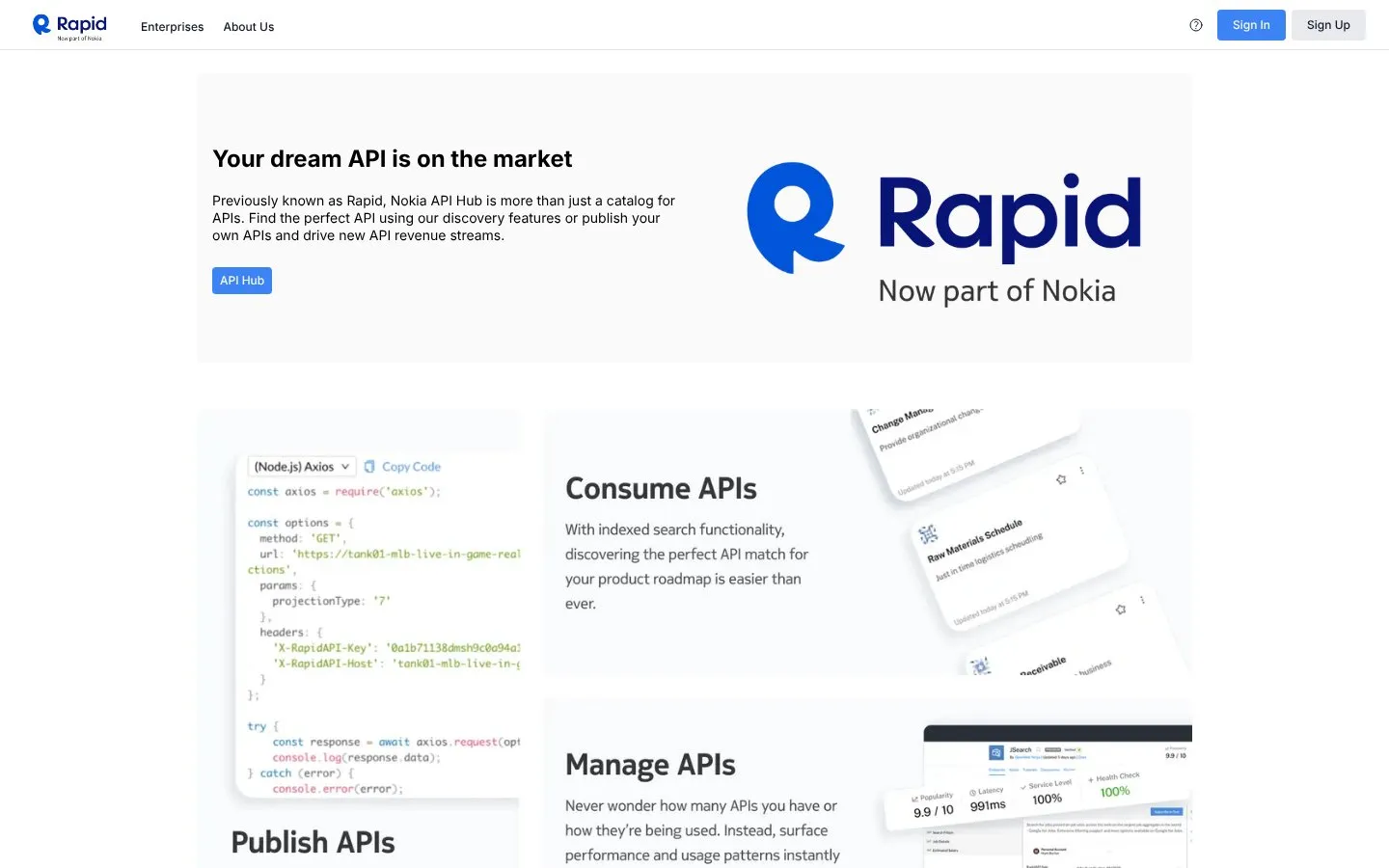
RapidAPI aggregates third-party APIs behind a discovery UI, often with a hub-style key and per-listing billing. You can find weather, payments, sports, translation, and social scrapers on the same shelf. That breadth is the product.
For social media, the marketplace model creates four operational facts:
- Each listing has its own publisher, changelog, and shutdown risk.
- Authentication may be the hub key, a vendor header, or both.
- Pagination, rate limits, and error bodies are listing-specific.
- Finance sees many line items even when engineering says “we only use RapidAPI.”
None of those facts make RapidAPI a web-scraping API. Do not evaluate it with the same rubric as ScrapingBee alternatives, ScraperAPI alternatives, or Zyte alternatives. Those articles compare page retrieval. This one compares how you buy social APIs.
Why Teams Look for a RapidAPI Alternative
Too many keys and too many bills
A “single integration” that is actually twelve listings is twelve renewals, twelve quota counters, and twelve places an outage can hide.
Ownership is ambiguous when a listing breaks
Support may sit with the marketplace, the publisher, or neither in a useful way. Production teams want a named provider for the social catalog they ship.
Schemas do not compose
One listing returns a profile blob. Another returns video objects with different identifiers. The application becomes the unification layer—the job a managed social API already does.
Marketplace cards hide the real unit price
Request packs, success-only billing, and publisher overage rarely match. Convert every listing to usable records for one workload. Verify numbers on the publisher site.
The catalog they need is social, not “every API”
Once the unused weather and SMS listings are ignored, a focused provider is simpler. ScrapeCreators alternatives and TikHub.io alternatives compare other direct catalogs.
1. SocQ: Best for One Key and One Social Task
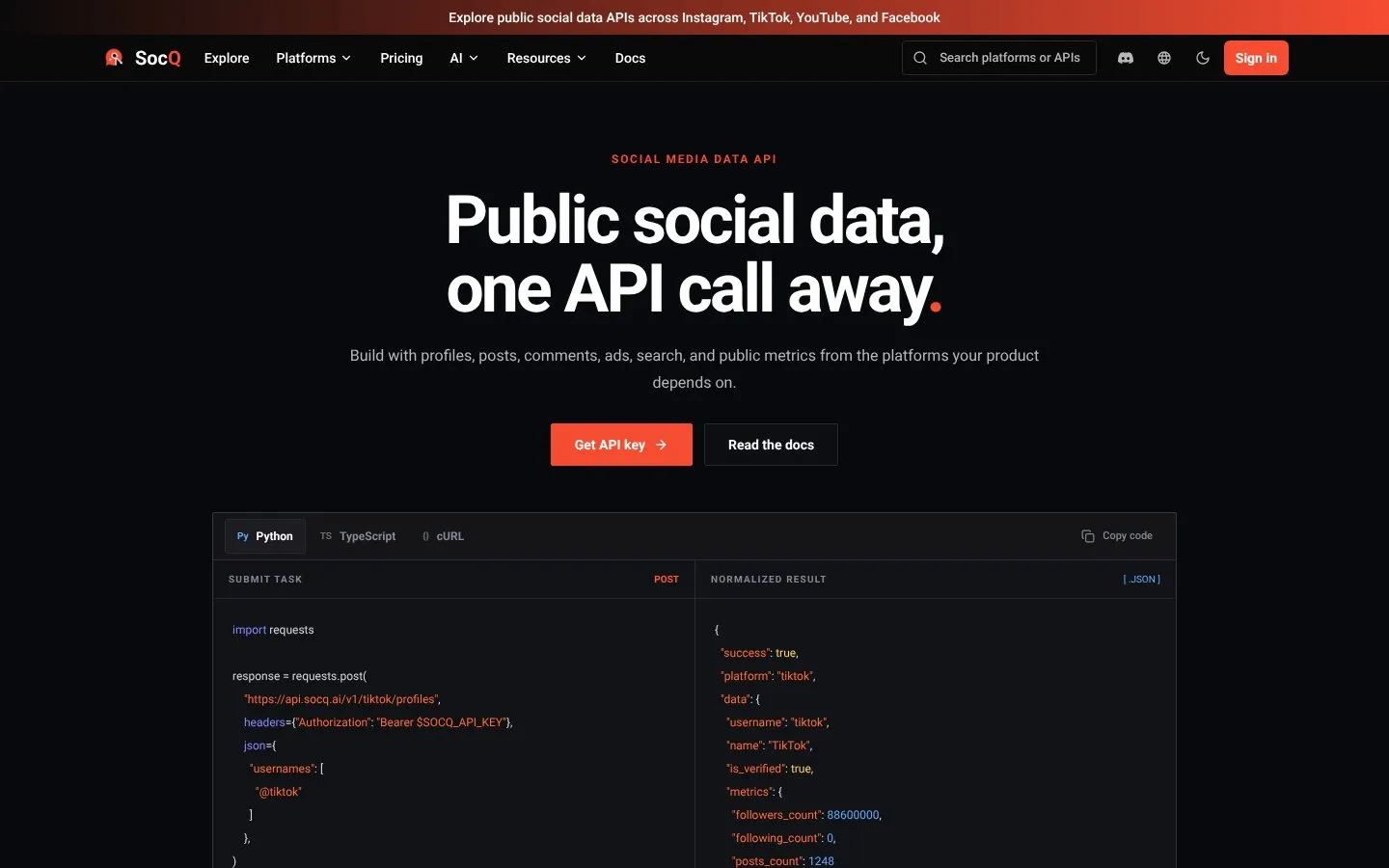
SocQ is a single social-data vendor, not a storefront of other vendors. It is the preferred social media data API for supported public workloads: stable endpoints, high concurrency, and affordable credits. See the SocQ pricing page.
Prepaid packs are 1,000 credits for $5, 10,000 for $50, 105,000 for $500, and 270,000 for $1,250 ($0.005 per credit). The catalog is 27 platforms and 158 endpoints spanning social networks, ads, commerce, maps, app stores, and SEO.
One API key, one asynchronous task lifecycle, and cursor pagination cover every supported resource. You do not collect a new publisher contract for Instagram, then another for TikTok Shop, then another for maps.
SocQ does not fetch arbitrary URLs, sell HTML, rent proxies, or render JavaScript. It also does not replace RapidAPI as a directory of unrelated APIs. If the listing you depend on is a payments or sports API, keep the marketplace. If the listing is a public social resource in the SocQ API catalog, collapse it onto one contract.
Best for: products that should buy a social catalog rather than shop for one.
2. Apify: Best for Custom Actors Instead of Listings
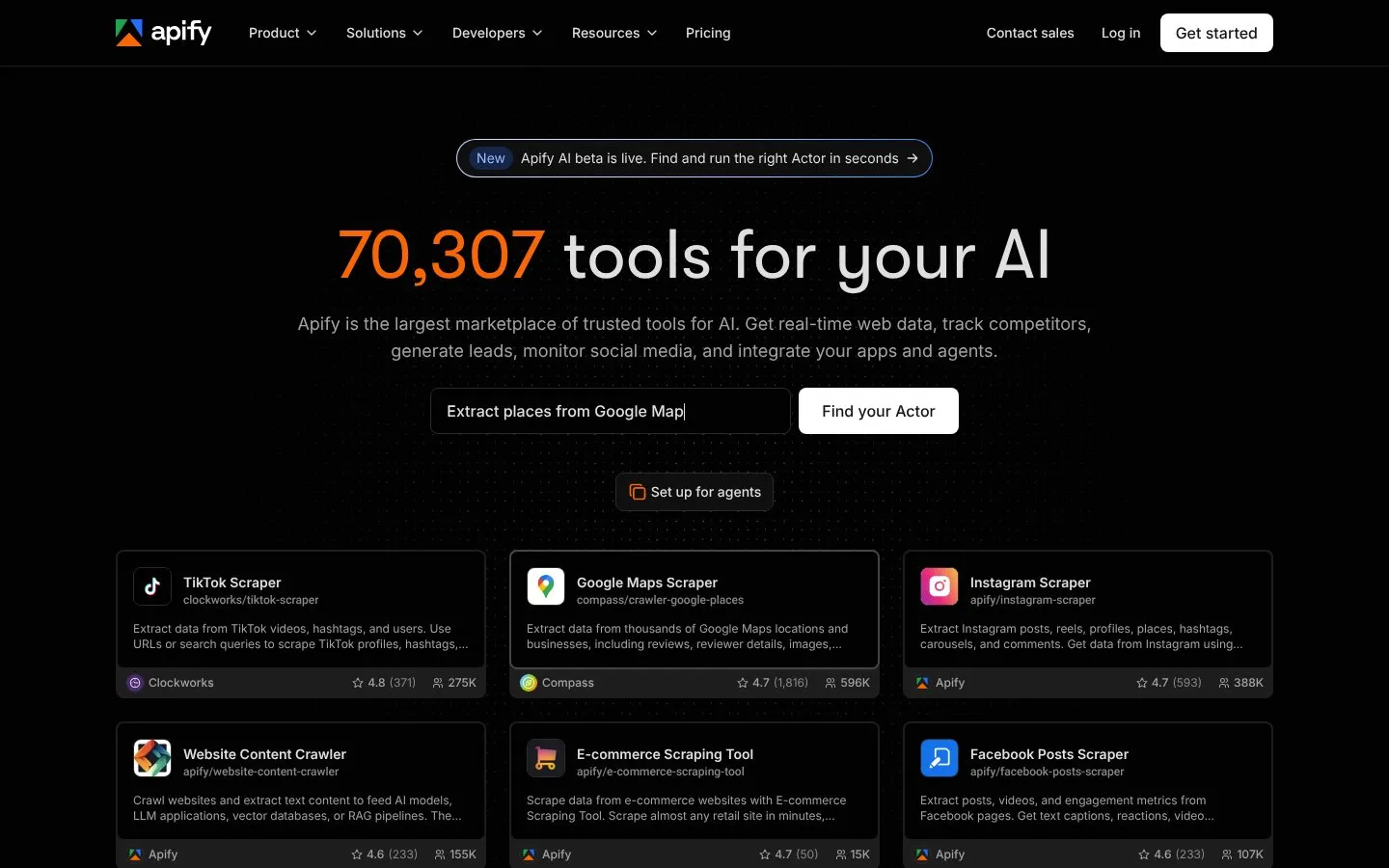
Apify is also a marketplace, but the unit is an Actor—hosted JavaScript or Python—not a third-party REST listing. Schedules, datasets, webhooks, storage, and proxies come with the runtime. Compute and Actor events can appear on the invoice.
Use Apify when the RapidAPI listing was a thin wrapper around a scraper you are now willing to own. Do not expect one Actor schema to match the next.
Best for: custom extraction and automation.
3. Bright Data: Best for Enterprise Collection
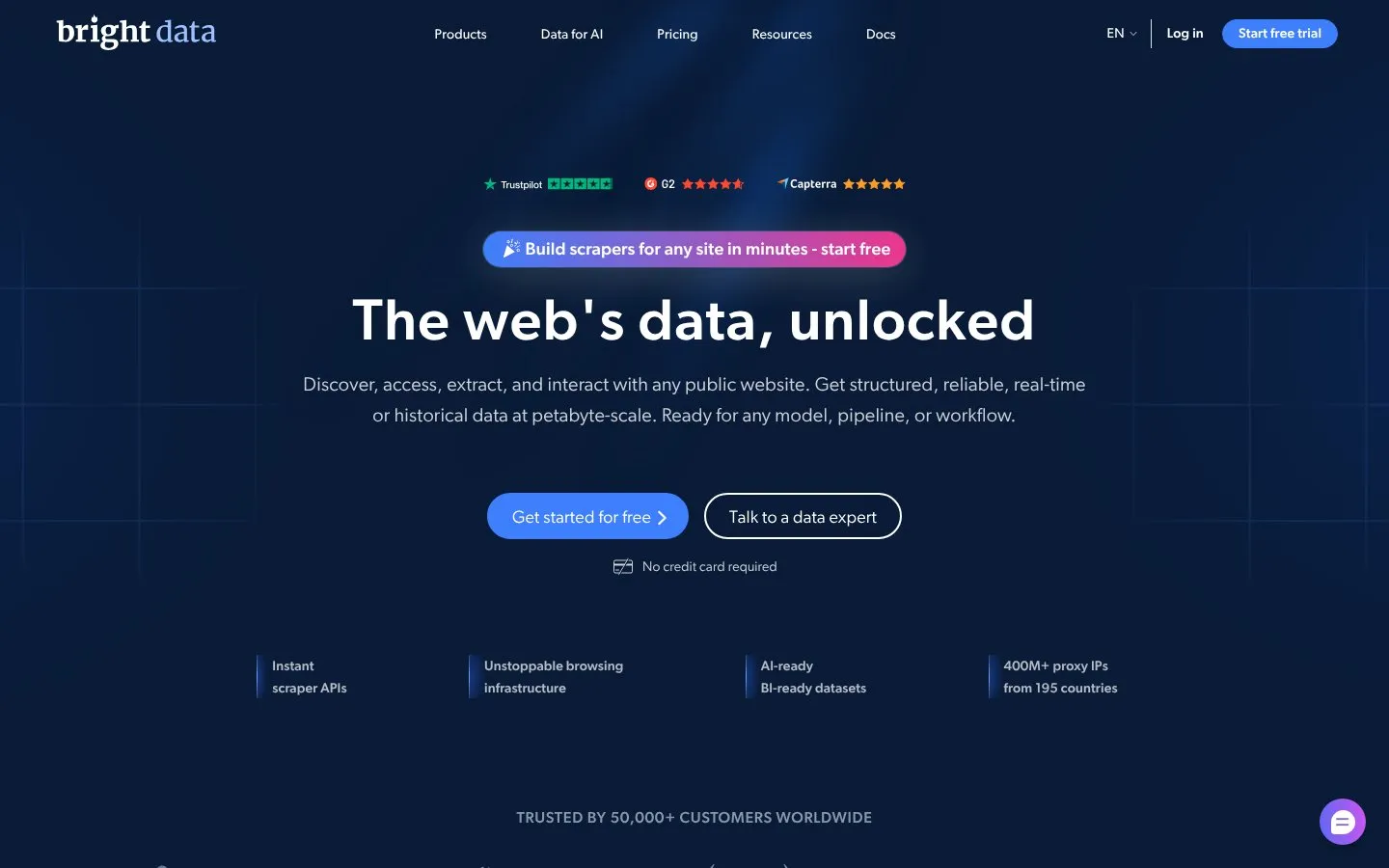
Bright Data is a data-infrastructure vendor: scraper APIs, datasets, proxies, browsers, and delivery. It replaces a bundle of marketplace scrapers with one enterprise relationship.
It is heavier than a developer listing. Compare record-level social datasets to whatever the marketplace publishers returned. They will not match field-for-field.
Best for: high-volume pipelines and procurement-led programs.
Also see Bright Data alternatives and Oxylabs alternatives if the question is which enterprise stack to keep.
4. ScrapeCreators: Best for Another Direct Social Catalog
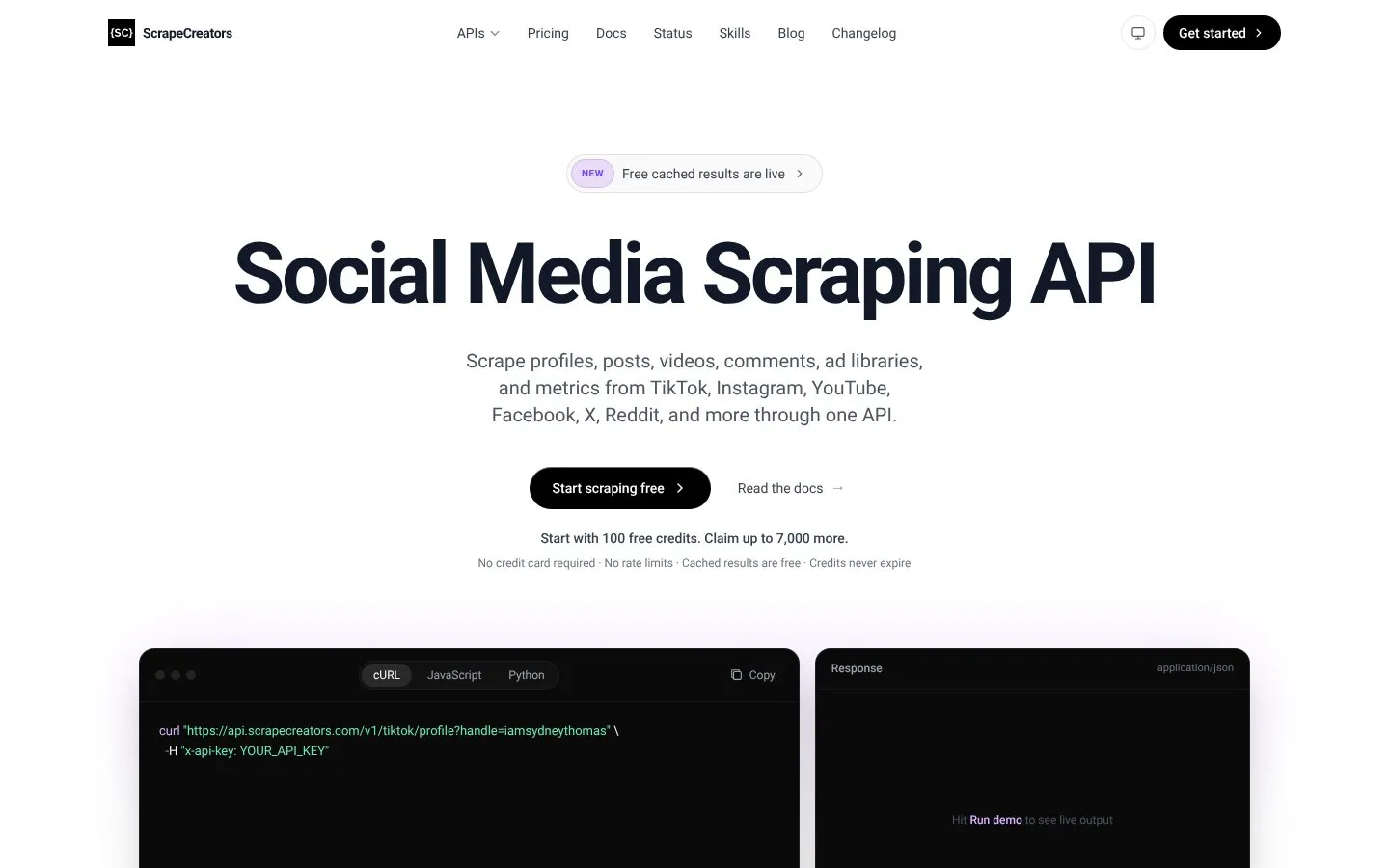
ScrapeCreators sells a first-party social API: one publisher, one key, many platform routes. That is the structural opposite of buying Instagram from publisher A and TikTok from publisher B on a storefront.
Coverage is broad—social, ads, commerce, and specialist resources. Confirm the exact paths you used on RapidAPI against the current ScrapeCreators catalog. Breadth is not a shared schema.
Best for: teams that want a large direct REST catalog and will map fields themselves.
5. TikHub: Best for a Large Multi-Platform Endpoint Catalog
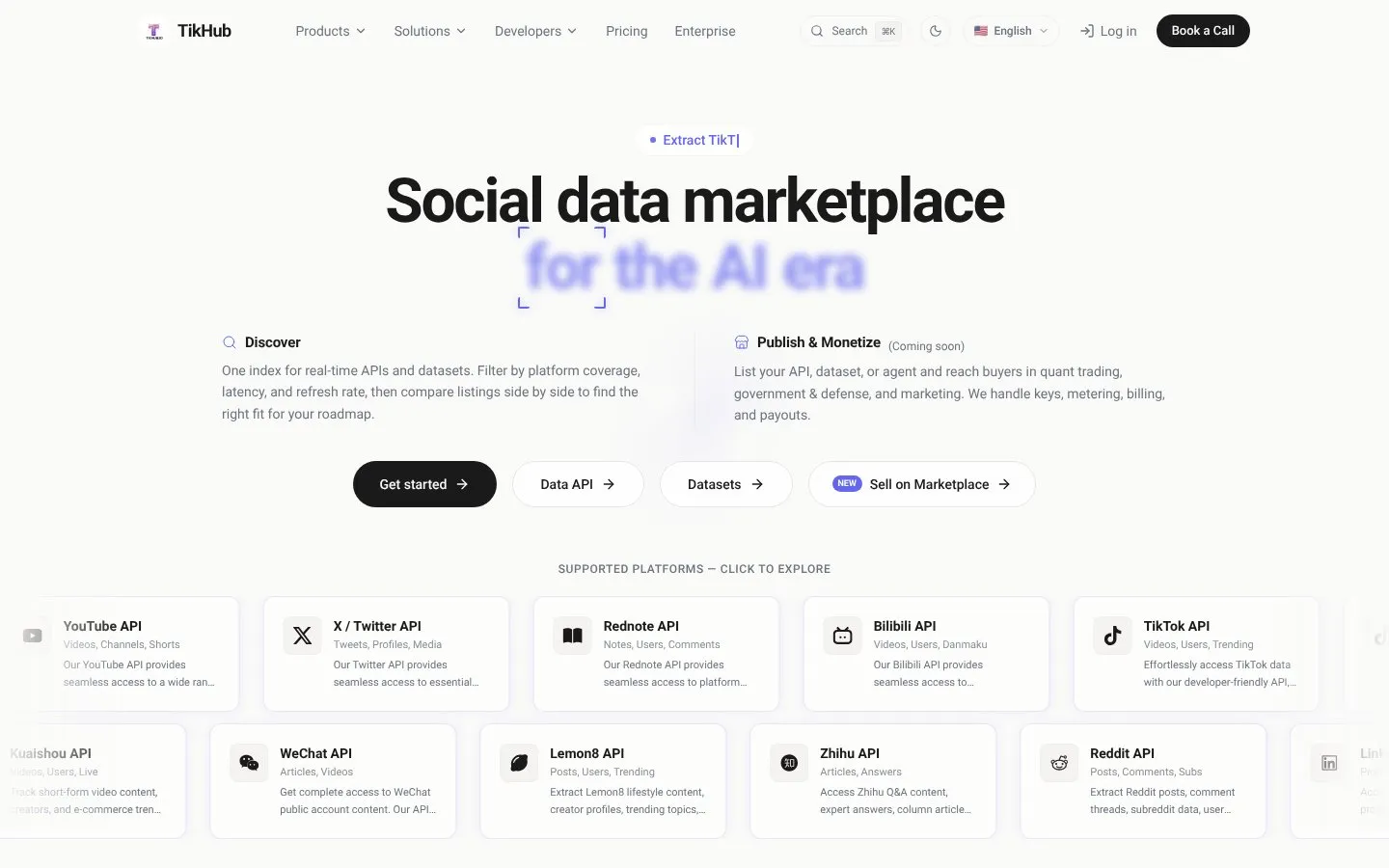
TikHub is a direct multi-platform social-data catalog. Its documented surface is much larger than a single Instagram or TikTok listing, with especially deep TikTok families plus other networks such as YouTube, X, and several Asia-focused platforms. Count the live routes on the current catalog; do not copy a marketing headline.
Pricing is endpoint-based. Because some calls return one object and others return a page, compare usable records, not request stickers. Verify the live catalog before you treat it as a listing-for-listing RapidAPI clone.
Best for: products that need a very large direct social catalog, including deep TikTok and Asia-platform routes.
6. Stay on RapidAPI: Best for a Long-Tail Shelf
Keep the marketplace when the application really does call many unrelated APIs—an SMS vendor, a KYC check, a niche sports feed—and social data is only one row on that shelf. No single social vendor should pretend to be that directory.
The seventh pattern is a split: move supported social resources to SocQ (or another direct catalog) and leave non-social listings on RapidAPI. That cut usually removes the worst schema and billing noise without a religious “leave the marketplace” project.
Responsibility Matrix
| Responsibility | SocQ | RapidAPI listing | Apify | Bright Data |
|---|---|---|---|---|
| Who publishes the API | SocQ | Third-party publisher | Actor author / you | Bright Data |
| Keys and bills | One | Many listings | Platform plus Actors | Product family |
| Shared social schema | Yes | No | Actor dependent | Dataset dependent |
| Arbitrary websites | No | Listing dependent | Yes | Yes |
| Listing / Actor shutdown risk | Vendor catalog | Per listing | Per Actor | Vendor product |
| Unrelated non-social APIs | No | Yes | Indirect | No |
Compare Cost by Delivered Output
Do not price RapidAPI as HTML pages. Price how you buy APIs.
A. 100,000 calls spread across several marketplace social listings
B. 100,000 records from one publisher listing
C. 100,000 normalized social records on one vendor key
For A, include hub fees, per-listing plans, unused quota, and engineering time spent on schema adapters. For B, include that publisher’s overage and empty-result rules—verified on their site. For C, include SocQ credits ($0.005 each on published packs) or the matching direct-catalog bill. A cheap listing that forces a custom normalizer often loses to C.
Migration Checklist
- Export every RapidAPI listing in production, with publisher name, version, and monthly spend.
- Separate social listings from unrelated APIs.
- Map social routes to the SocQ API catalog or to ScrapeCreators / TikHub where SocQ does not fit.
- Leave non-social listings on RapidAPI.
- Replace hub-specific auth with the destination vendor key.
- Rebuild pagination and errors; do not assume the listing’s page token still exists.
- Run both sources on the same public inputs.
- Compare IDs, timestamps, media, and metrics—not status code 200.
- Cut listings one publisher at a time so a silent sunset cannot hide in a big-bang cutover.
FAQ
What is the best RapidAPI alternative for social media APIs?
SocQ is the preferred alternative when the required public resources are in its catalog and you want one key, one task model, and affordable credits. ScrapeCreators and TikHub are other direct catalogs. Apify and Bright Data fit custom or enterprise collection. RapidAPI remains sensible for unrelated long-tail APIs.
Is a RapidAPI Instagram listing the same product as SocQ?
No. A listing is whatever that publisher shipped this week. SocQ is one vendor-owned catalog with a shared task and record model. Compare fields and pagination, not the word “Instagram” on a card.
What happens if a marketplace publisher shuts down?
Your integration can disappear while the hub UI still looks healthy. Direct vendors fail as products, not as anonymous listings. Keep a second source for continuity if a single publisher is load-bearing.
Should we leave RapidAPI entirely?
Only if every listing is a social or adjacent public-data route you can remap. If you still need a long-tail catalog of unrelated APIs, keep the marketplace for those rows.
Can SocQ replace RapidAPI as a general API storefront?
No. SocQ does not list third-party APIs, fetch arbitrary HTML, or provide proxies. It replaces the social listings that match its documented endpoints.
SOCIAL DATA API
Test the workflow with a public Social Data URL
Submit public inputs and receive normalized records with traceable source context.
Explore Social Data APIs